Book Synopsis
What if a dream was more than a dream? What if it was a warning from God?
In Dreams Come True, Pastor Joel shares a powerful and unforgettable dream that unveils startling prophetic revelations connected to the Fourth Beast of Daniel 7 and the rise of the Antichrist system in the last days. Through vivid symbolism, biblical insight, and urgent spiritual truth, this compelling book challenges believers to awaken spiritually and discern the times we are living in.
Blending prophecy, personal testimony, and Scripture, Joel Martin calls the body of Christ to prayer, holiness, wisdom, and unwavering faith in Jesus Christ. This is not a message of fear, but a call to preparation, repentance, and hope for those who are ready to hear what the Spirit is saying.
Dreams Come True is a wake-up call for a sleeping world—and an encouragement for believers to stand firm as the return of Christ draws near.
Publication Date: September 17, 2013
Book Size: 6″ x 9″
Pages: 78
Binding: Perfect Bound
Color: Standard Black & White
Cover Finish: Glossy
Paper: 60# Uncoated White
ISBN: 9781467588577 – A copy of this book is recorded in the libray of congress – USA.
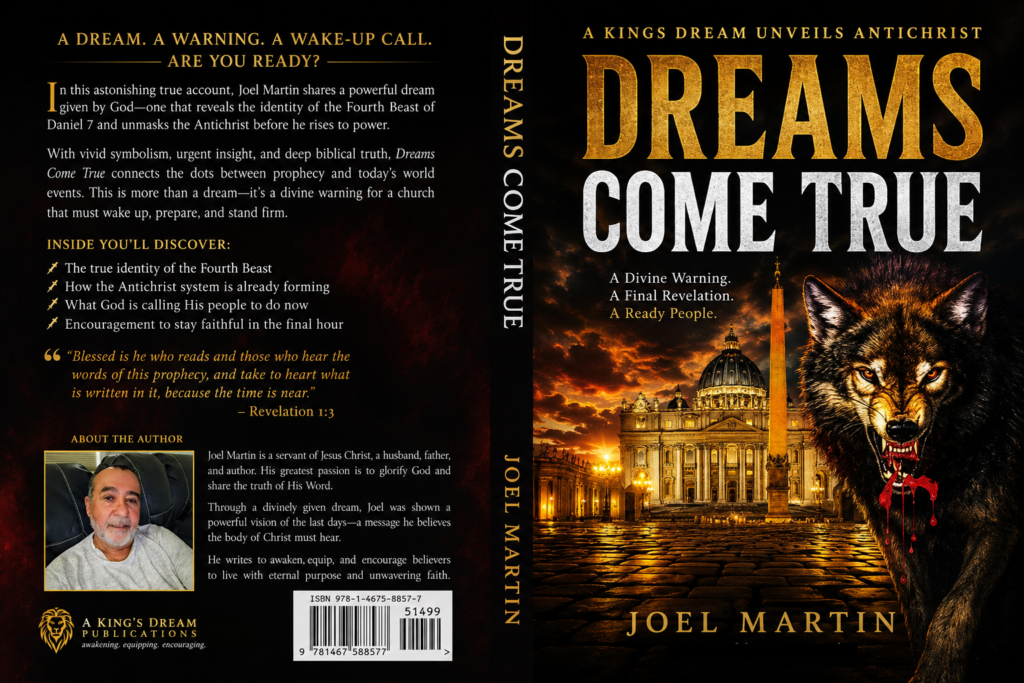
This book a available as a 6×9″ Perfect Bound Paperback with Glossy cover for $14.99 – If you are interested in purchasing this book in paperback format please contact Pastor Joel and let him know you are interested in purchasing this book. $14.99 does not include shipping.
You may now read this book for free…. Enjoy your reading!
DREAMS COME TRUE
“A KINGS DREAM UNVEILS ANTICHRIST”
DREAMS COME TRUE
Volume One
✦ ✦ ✦
“A King’s Dream Unveils Antichrist”
King Nebuchadnezzar of Babylon had a dream several
thousand years ago that reveals the Antichrist.
by
Joel Martin
DREAMS COME TRUE — VOLUME ONE
Copyright © 2013 by Joel Martin – Biblical Author & Teacher
All rights reserved. No part of this book may be reproduced or transmitted in any form or by any means without written permission from the author.
ISBN: 978-1-4675-8857-7
To order more printed copies of this paperback book in 6×9” perfect bound format with glossy cover, please visit our Church Website.
Printed in USA
World Rights Reserved.
Dedication
✦ ✦ ✦
This book is dedicated to anyone who will heed the prophecies and warnings written on the pages of the Bible, and the interpretation of a dream King Nebuchadnezzar of Babylon had several thousand years ago that reveals the Antichrist.
Revelation 14:9-12
“9And the third angel followed them, saying with a loud voice, If any man worship the beast and his image, and receive his mark in his forehead, or in his hand, 10The same shall drink of the wine of the wrath of God, which is poured out without mixture into the cup of his indignation; and he shall be tormented with fire and brimstone in the presence of the holy angels, and in the presence of the Lamb: 11And the smoke of their torment ascendeth up for ever and ever: and they have no rest day nor night, who worship the beast and his image, and whosoever receiveth the mark of his name. 12Here is the patience of the saints: here are they that keep the commandments of God, and the faith of Jesus.”
Revelation 13:16-18
“16And he causeth all, both small and great, rich and poor, free and bond, to receive a mark in their right hand, or in their foreheads: 17And that no man might buy or sell, save he that had the mark, or the name of the beast, or the number of his name. 18Here is wisdom. Let him that hath understanding count the number of the beast: for it is the number of a man; and his number is Six hundred threescore and six.”
666 is the number of the beast, this book you are holding in your hand, has counted the number to identify the Antichrist.
Table of Contents
✦ ✦ ✦
Dedication 3
Preface 5
Introduction 6
CHAPTERS
1 Ancient Empires in Bible Prophecy 8
2 The Dream Revealed 14
3 Four World Kingdom Empires 18
4 Revelation of Jesus Christ 43
5 The Physical Birth Year of Jesus Christ 53
6 The Revelation of John 58
7 The Kingdom of God Revealed 75
Final Words 78
Preface
✦ ✦ ✦
This book takes you back in time through a walk through history to look closely at the writings, visions, and interpretations of the Prophet Daniel as given in the Bible.
God gave Daniel accurate information about future kingdom empires that were to rise to power in the world before they ever existed. With great precision and perfect timing, Daniel foretold of four great empires that were to arise as world empires. All four empires rose to power exactly as Daniel foretold. When we study world history combined with the prophecies found in the book of Daniel, we can see that the information Daniel received serves as evidence to all the world that the Word of God is infallible and accurate!
As God walks Daniel through four great world empires, Daniel is given valuable insight about future events that must unfold — events that lead into the days in which you and I now live. In addition to the visions Daniel was given, God reveals to His prophet the month and year in which Jesus Christ was to be born and begin His earthly ministry.
God also reveals to Daniel what it will be like living in the last days, just before Jesus Christ appears in the clouds of heaven to redeem His Church!
Enjoy your reading!
By Author Joel Martin
Introduction
✦ ✦ ✦
This book endeavors to walk you through the books of Daniel and Revelation as it pinpoints four world kingdom empires that arose to power long before they ever existed.
The great prophetic book of Daniel reveals the last nation that will rise to power to promote the evil agenda of the Antichrist before the Lord Jesus Christ appears in the sky to save His people.
According to Daniel, all the world empires will be subdued and destroyed at the Second Coming of Jesus when He appears in the sky with all His angelic hosts.
Understanding the prophecies spoken of by the prophet Daniel can easily be accomplished by looking at world history. As we look back at world history and the biblical prophecies outlined in both the books of Daniel and Revelation, one can very easily trace and link the lineage of the Antichrist even up to our day.
History shows that the four great world empires came into power, then fell. The fourth and last kingdom will exist until Jesus Christ returns to save His people from this last evil empire. The Kingdom of God will overpower and destroy this last earthly kingdom “system” and defeat it forever! God will then establish His kingdom at the appointed time.
The intent of this book is to give the reader an understanding of who the Antichrist is and where the Antichrist will come from. This book also serves as “prophetic biblical evidence” that God is all-knowing and all-powerful, and that His Word — the Bible — is above all the kingdoms of the world!
This book walks its reader through all four empires identified in the Bible, along with historical facts that bring to light the prophetic writings of Daniel. Understanding the visions and prophetic symbolic messages identified in the book of Daniel will deepen your faith in God and provide proof that the Word of our LORD is accurate and true!
In Matthew 5:18, Jesus said these words:
“For truly I say to you, until heaven and earth pass away, not the smallest letter or stroke shall pass from the Law until all is accomplished.”
The Word of the Lord will never pass away! After reading this book, you will have a clear understanding of what Jesus meant when He said, “Heaven and earth will pass away, but My word will never pass away.” The Lord is exalted above all the earth and above all nations.
Chapter 1
Ancient Empires in Bible Prophecy
✦ ✦ ✦
The prophet Daniel’s life and ministry bridged the entire seventy-year period of Babylonian captivity. Daniel became the “mouthpiece” to both the Gentile and Jewish worlds as he declared what he was shown by God in night visions and dreams.
Daniel lived in captivity under the rule of King Nebuchadnezzar of Babylon, who went to Jerusalem and besieged it. This took place during the third year of the reign of Jehoiakim, king of Judah. We learn that the Lord delivered Jehoiakim, king of Judah, into the hand of the king of Babylon, along with some of the articles he took from the temple of God when he overthrew Judah. Nebuchadnezzar carried these articles to the temple of his god in Babylonia and put them in the treasure house of his god. [Daniel 1:1]
Jehoiakim was the son of one of the best kings who ever sat upon the throne of David. His father, Josiah, feared the Lord from his youth. In a period of great degeneracy, he was enabled to live a holy and consistent life. Convinced that religion is the true source of national prosperity and that sin is the cause of national calamity, Josiah exerted his royal influence to promote the revival of godliness among his subjects.
The Hebrew people of Judah felt comfortable and safe as long as the temple in which they worshiped remained among them. In one of the earlier proclamations from the prophet Jeremiah, God sent Jeremiah to warn the nations against this delusion [Jeremiah 4:4, 12–14].
This threatening judgment God began to execute because of the rebellion of Judah. Literally, “judgment began at the house of God.”
Having conquered Jerusalem, Nebuchadnezzar entered the temple and carried away part of the vessels of the Lord’s house. These he took into the land of Shinar, the ancient name of the region in which Babylon was situated, and placed them in the treasure house of his god. Considering the place from which these vessels had been taken and to whose service they had been consecrated for ages, they may certainly be regarded as one of the most remarkable trophies that any conqueror ever presented at the shrine of his deity.
After Nebuchadnezzar besieged Jerusalem, he ordered Ashpenaz, chief of his court officials, to bring into the king’s service certain young men of the children of Israel who were from the royal family of Jehoiakim, king of Judah.
The king ordered Ashpenaz to seek young men without any physical defect — handsome, showing aptitude for every kind of learning, well-informed, quick to understand, and qualified to serve in the king’s palace. He was to teach them the language and literature of the Babylonians. [Daniel 1:3–4]
Daniel, a young Jewish man, along with a few of his fellow Hebrew friends from Judah, was chosen and appointed to serve under King Nebuchadnezzar of Babylon. Their Hebrew names were Daniel, Hananiah, Mishael, and Azariah. The chief official gave them new names: to Daniel, the name Belteshazzar; to Hananiah, Shadrach; to Mishael, Meshach; and to Azariah, Abednego. [Daniel 1:5–7]
The king of Babylon assigned them a daily amount of food and wine from the king’s table, but Daniel purposed in his heart not to defile himself with the king’s food and drink. They were to be trained in the customs and culture of Babylon for three years, and after three years they were to enter the king’s service.
Daniel resolved not to defile himself with the royal food and wine, and he asked the chief official for permission not to do so. God gave Daniel favor, and the official showed compassion to him, but told Daniel, “I am afraid of my lord the king, who has assigned your food and drink. Why should he see you looking worse than the other young men your age? The king would then have my head because of you.” [Daniel 1:8–10]
Daniel assured the official assigned over him that he and his three Hebrew friends would not look worse than the others if they did not eat and drink the king’s daily provisions. He requested that they be given only vegetables and water for ten days. Daniel told Melzar, the official over him, that after ten days he could examine their appearance and deal with them accordingly. Melzar agreed, took away the meat, and granted Daniel’s request. After ten days they looked healthier and better nourished than all the young men who ate the king’s food. [Daniel 1:8–16]
These four young Jewish men faced the aftermath of war upon their people, along with the challenge of serving a demanding ungodly ruler and learning a new language and culture simply to coexist in society. The present world conditions must have seemed difficult enough for them under this new world order.
To make matters worse, their ruthless new king was troubled by a dream and wanted someone within his royal palace to reveal and interpret it to him — or he would sentence them to death. In the second year of his reign, King Nebuchadnezzar had dreams; his mind was troubled to the point of losing sleep. So, the king summoned his magicians, enchanters, sorcerers, and astrologers from within his kingdom so that they could reveal to him what he had dreamed. When they came in and stood before the king, he said to them, “I have had a dream that troubles me, and I want to know what it means.” [Daniel 2:1–3]
The magicians, enchanters, sorcerers, and astrologers answered the king, “May the king live forever! Tell your servants the dream, and we will interpret it.” The king replied, “This is what I have firmly decided: If you do not tell me what my dream was and interpret it, I will have you cut into pieces and your houses turned into piles of rubble. But if you tell me the dream and explain it, you will receive from me gifts and rewards and great honor. So tell me the dream and interpret it for me.” Once more they replied, “Let the king tell his servants the dream, and we will interpret it.” [Daniel 2:4–7]
The magicians, enchanters, sorcerers, and astrologers answered the king, “There is no one on earth who can do what the king asks! No king, however great and mighty, has ever asked such a thing of any magician, enchanter, sorcerer, or astrologer. What the king asks is too difficult. No one can reveal it to the king except the gods, and they do not live among humans.” This made the king so angry and furious that he ordered the execution of all the wise men of Babylon.
So the decree was issued to put the wise men to death, and men were sent to look for Daniel and his friends to put them to death as well. Daniel and his friends were in danger by association, because they too were considered wise men within the king’s courts. Daniel and his three Hebrew friends were not magicians, enchanters, or sorcerers, yet they were included in the king’s decree because the king’s magicians, enchanters, and sorcerers could not reveal and interpret his dream.
When Arioch, the commander of the king’s guard, had gone out to put to death the wise men of Babylon, Daniel spoke to him with wisdom and tact. He asked the king’s officer, “Why did the king issue such a harsh decree?” Arioch then explained the matter to Daniel. At this, Daniel went to the king and asked for time so that he might interpret the dream for him. Then Daniel returned to his house and explained the matter to his friends Hananiah, Mishael, and Azariah. He urged them to plead for mercy from the God of heaven concerning this mystery, so that he and his friends might not be executed with the rest of the wise men of Babylon.
During the night, the mystery was revealed to Daniel in a vision. Then Daniel praised the God of heaven and said: “Praise be to the name of God forever and ever; wisdom and power are His. He changes times and seasons; He deposes kings and raises up others. He gives wisdom to the wise and knowledge to the discerning. He reveals deep and hidden things; He knows what lies in darkness, and light dwells with Him. I thank and praise You, God of my ancestors: You have given me wisdom and power, You have made known to me what we asked of You, You have made known to us the dream of the king.” [Daniel 2:10–23]
The four Hebrew men faced the death penalty simply because no one in Nebuchadnezzar’s kingdom was able to reveal and interpret his dream. All the unbelieving magicians, enchanters, sorcerers, and astrologers were facing death. Daniel and his Hebrew friends were also facing the death penalty for something they had nothing to do with.
The world conditions of Daniel’s day were not easy. The four young Jewish men had already dealt with defeat when Babylon invaded their homeland Jerusalem, not to mention that they had ended up in the palace of an ungodly king and were now facing the death penalty for something in which they had no part.
The day King Nebuchadnezzar passed the decree to put to death all the wise men in his kingdom — simply because they were unable to reveal and interpret his troublesome dream — was the day God intervened and began to reveal the future of world events to Daniel in a dream, using symbolic language and imagery. Little did Daniel know that his interpretation of the king’s dream would change the world when he stood before the king to reveal it.
In a desperate situation, the young prophet Daniel found hope that spared not only his life, but the lives of his Hebrew friends and even the lives of the magicians, enchanters, sorcerers, and astrologers. When Daniel prayed to the only true and living God in heaven, God answered him in a dream which revealed and interpreted the king’s vision. This event changed the course of world history and revealed to us today the things we are to expect before the great Day of the Lord — the Second Coming of Jesus Christ!
The revelation given to Daniel kicked off a series of world events revealed in a perfect timeline that walks us through the rise and fall of great world empires thousands of years before they ever took power. The last part of the dream and its interpretation leads up to the time in which you and I now live — or as Daniel describes it, “the time of the end,” which some are calling today “the last days” or “the end times.”
As we take a close look at the troublesome dream Nebuchadnezzar had, we find Daniel standing before the king of Babylon, prophesying about the future of the Babylonian kingdom and the kingdoms that are to come!
Chapter 2
The Dream Revealed
✦ ✦ ✦
In the book of Daniel, chapter 2, verses 24–48, Daniel interprets the dream to the king of Babylon.
v24 Then Daniel went to Arioch, whom the king had appointed to execute the wise men of Babylon, and said to him, “Do not execute the wise men of Babylon. Take me to the king, and I will interpret his dream for him.” v25 Arioch took Daniel to the king at once and said, “I have found a man among the exiles from Judah who can tell the king what his dream means.” v26 The king asked Daniel (also called Belteshazzar), “Are you able to tell me what I saw in my dream and interpret it?” v27 Daniel replied, “No wise man, enchanter, magician, or diviner can explain to the king the mystery he has asked about, v28 but there is a God in heaven who reveals mysteries. He has shown King Nebuchadnezzar what will happen in days to come. Your dream and the visions that passed through your mind as you were lying in bed are these:”
v29 “As Your Majesty was lying there, your mind turned to things to come, and the Revealer of mysteries showed you what is going to happen. v30 As for me, this mystery has been revealed to me, not because I have greater wisdom than anyone else alive, but so that Your Majesty may know the interpretation and understand what went through your mind.
v31 “Your Majesty looked, and there before you stood a large statue — an enormous, dazzling statue, awesome in appearance. v32 The head of the statue was made of pure gold, its chest and arms of silver, its belly and thighs of bronze, v33 its legs of iron, its feet partly of iron and partly of baked clay. v34 While you were watching, a rock was cut out, but not by human hands. It struck the statue on its feet of iron and clay and smashed them. v35 Then the iron, the clay, the bronze, the silver, and the gold were all broken to pieces and became like chaff on a threshing floor in the summer. The wind swept them away without leaving a trace. But the rock that struck the statue became a huge mountain and filled the whole earth. v36 This was the dream, and now we will interpret it to the king.”
The Interpretation of the Dream
Daniel chapter 2 continued . . .
Babylonian kingdom empire revealed: v37 “Your Majesty, you are the king of kings. The God of heaven has given you dominion and power and might and glory; v38 in your hands He has placed all mankind and the beasts of the field and the birds in the sky. Wherever they live, He has made you ruler over them all. You are that head of gold.
Medo-Persian kingdom empire revealed: v39 “After you, another kingdom will arise, inferior to yours.
Greek kingdom empire revealed: v39 “Next, a third kingdom, one of bronze, will rule over the whole earth.
Roman kingdom empire revealed: v40 “Finally, there will be a fourth kingdom, strong as iron — for iron breaks and smashes everything, and as iron breaks things to pieces, so it will crush and break all the others.
Divided Roman kingdom empire revealed: v41 “Just as you saw that the feet and toes were partly of baked clay and partly of iron, so this will be a divided kingdom; yet it will have some of the strength of iron in it, even as you saw iron mixed with clay. v42 As the toes were partly iron and partly clay, so this kingdom will be partly strong and partly brittle. v43 And just as you saw the iron mixed with baked clay, so the people will be a mixture and will not remain united, any more than iron mixes with clay.
The Kingdom of God revealed: v44 “In the time of those kings, the God of heaven will set up a kingdom that will never be destroyed, nor will it be left to another people. It will crush all those kingdoms and bring them to an end, but it will itself endure forever.
Christ, the Rock Kingdom, revealed: v45 “This is the meaning of the vision of the rock cut out of a mountain, but not by human hands — a rock that broke the iron, the bronze, the clay, the silver, and the gold to pieces. The great God has shown the king what will take place in the future. The dream is true and its interpretation is trustworthy.”
v46 Then King Nebuchadnezzar fell prostrate before Daniel and paid him honor, and ordered that an offering and incense be presented to him. v47 The king said to Daniel, “Surely your God is the God of gods and the Lord of kings and a Revealer of mysteries, for you were able to reveal this mystery.”
v48 Then the king placed Daniel in a high position and lavished many gifts on him. He made him ruler over the entire province of Babylon and placed him in charge of all its wise men. v49 Moreover, at Daniel’s request the king appointed Shadrach, Meshach, and Abednego as administrators over the province of Babylon, while Daniel himself remained at the royal court.
As we examine the dream of King Nebuchadnezzar in scripture, we find important information and mysteries about God, world history, and the continued prophetic events that must come to pass at appointed times and seasons.
Chapter 3
Four World Kingdom Empires
✦ ✦ ✦
Listed below are some facts about Nebuchadnezzar’s dream that help us understand God’s plan for all the kingdoms of the world. God reveals to us in the book of Daniel four major world empires throughout time, until the time in which Jesus Christ sets up His Kingdom here on earth. The dream begins with the first great world empire — Babylon — which existed after the flood of Noah.
To understand the book of Revelation, we must first read and understand the prophetic writings and symbolism in the book of Daniel. In later chapters of this book you will also learn that God mentions Babylon again in the book of Revelation, but for now we will look only at the book of Daniel and learn what Daniel prophesied to the king of Babylon in his day!
First, look at all the characteristics of the dream in Daniel 2:
v27 — No wise man, enchanter, magician, or diviner can explain the dream to the king; only Daniel can. v28 — Only God can reveal mysteries and things that are to come to pass in the future of the world. v31 — A symbolic enormous, dazzling statue, awesome in appearance, represents world empires. v32 — The head of the statue was made of pure gold; its chest and arms of silver; its belly and thighs of bronze; v33 — its legs of iron, its feet partly of iron and partly of baked clay. v34 — A rock was cut out, but not by human hands. It struck the statue on its feet of iron and clay and smashed all the kingdoms of the world, representing the final and last kingdom to be established. v35 — Then the iron, the clay, the bronze, the silver, and the gold were all broken to pieces and became like chaff on a threshing floor in summer. The wind swept them away without leaving a trace. But the rock that struck the statue became a huge mountain and filled the whole earth. v36 — Daniel interprets the dream to the king. v38 — The Babylonian empire is the head of gold. v39 — After the Babylonian empire, another kingdom will arise, inferior to Babylon. Next, a third kingdom empire, one of bronze, will rule over the whole earth. v40 — Finally, there will be a fourth kingdom empire, strong as iron. v41 — The feet and toes were partly of baked clay and partly of iron, so this will be a divided kingdom empire. v43 — The divided kingdom will not remain united. v44 — The God of heaven will set up a Kingdom that will never be destroyed!
v48 — Daniel is promoted to a high position, and the king of Babylon lavished many gifts on him. He made Daniel ruler over the entire province of Babylon and placed him in charge of all its wise men, because Daniel revealed the dream and its interpretation, and all lives were spared because of Daniel’s reverence to God.
History has already proven that the Word of God is 100% accurate. The dream that Nebuchadnezzar had was given long before any great world empires arose to power or ever existed. The four world empires of Daniel’s vision are found in Daniel chapter 2 and described in detail long before the Babylonian empire was defeated and conquered by the Medo-Persian empire, as history reveals.
The fact that history alone has proven what Daniel was shown and prophesied about these empires — thousands of years before they came to power — should be enough to convince even the most skeptical person on the planet! The Word of God is true and inerrant when one examines both history and Bible prophecy!
“Whoso is wise and will observe these things, even they shall understand the loving-kindness of the LORD.” — Psalm 107:43
“The fear of the LORD is the beginning of knowledge; but fools despise wisdom and instruction.” — Proverbs 1:7
A look into history reveals the four great world empires that existed after the flood of Noah.
1. The Babylonian Empire — The Head of Gold
The Babylonian Empire is the first great world empire after the flood of Noah and is the head of gold mentioned in Daniel chapter two.
The city of Babylon was the capital of the ancient land of Babylonia in southern Mesopotamia. It was situated on the Euphrates River about fifty miles south of modern Baghdad, just north of what is now the modern Iraqi town of al-Hillah.
The tremendous wealth and power of this city, along with its monumental size and appearance, were once considered a biblical myth — until its foundations were unearthed and its riches substantiated during the nineteenth century. Archaeologists stood in awe as their discoveries revealed that certain stories in the Bible described actual historical events. A quick overview of the writings of the prophet Isaiah, especially chapter 13, reveals some predictions concerning Babylon that stagger the imagination. Babylon is the Akkadian “babilani,” which means “the Gate of God(s),” and it became the capital of the land of Babylonia.
The etymology of the name Babel in the Bible means “confused” (Gen. 11:9), and throughout the Bible, Babylon was a symbol of the confusion caused by godlessness. The name Babylon is the Greek form of the Hebrew name Babel. Babylon lies in the land of Shinar as revealed in the Bible (Gen. 10:10), and its general location has never been disputed. The Bible reveals that all false systems of religion began in the land of Babylon and will have their consummation from the spirit of Babylon in the last days. It is interesting to note that every organized system of religion in the world today has traces of ancient Babylon.
The Bible records in Genesis 10:10 that, after the great flood, all men spoke one common language and a man named Nimrod built a city and established a common religion. Nimrod was a descendant of Noah’s son Ham. Genesis 11:1–9 describes the building of the city and its famous tower “whose top may reach unto heaven.” It also records how God came down and punished the people’s arrogance by creating a confusion of different languages and possibly their racial distinctions, forcing man to obey God’s original command to “be fruitful and fill the whole earth.” It is interesting that the materials used to build the Tower of Babel were the same as those employed for the construction of the great ziggurat of Babylon and similar ziggurats, according to ancient building inscriptions. There is evidence that man has lived in this area of Mesopotamia since the beginning of civilization.
The first records indicate that Babylon was established as a city around the twenty-third century BC. Before this, it was a provincial capital ruled by the kings of the city of Ur. Then came the migration of the Amorites. Babylonia was an ancient empire that existed in the Near East in southern Mesopotamia between the Tigris and the Euphrates Rivers.
Throughout much of their history, their main rival for supremacy were the Assyrians. It was the Babylonians, under King Nebuchadnezzar II, who destroyed Jerusalem, the capital of the Kingdom of Judah, and carried God’s covenant people into captivity in 587 BC.
The Bible reveals much about the Babylonians all the way back from the time of Hammurabi (2000 BC) to the fall of Babylon around 500 BC. Throughout the Old Testament there are references to the Babylonians, their people, culture, religion, and military power. Babylonia was a long, narrow country about forty miles wide at its widest point and having an area of about 8,000 square miles. It was bordered on the north by Assyria, on the east by Elam, on the south and west by the Arabian desert, and on the southeast by the Persian Gulf.
The earliest known inhabitants of Mesopotamia were the Sumerians, whom the Bible refers to as the people of the “land of Shinar” (Gen. 10:10). Sargon, from one of the Sumerian cities, united the people of Babylonia under his rule about 2300 BC. Many scholars believe that Sargon might have been the same person as Nimrod (Gen. 10:8). Around 2000 BC, Hammurabi emerged as the ruler of Babylonia. He expanded the borders of the empire and organized its laws into a written system, also known as the Code of Hammurabi. About this time, Abraham left Ur, an ancient city located in lower Babylon, and moved to Haran, a city in the north. Later, Abraham left Haran and migrated into the land of Canaan under God’s promise that he would become the father of a great nation (Gen. 12). Alongside Babylonia, there must also be mention of Assyria, which bordered Babylonia on the north.
Assyria’s development was often intertwined with the course of Babylonian history. About 1270 BC, the Assyrians overpowered Babylonia. For the next seven hundred years, Babylonia was a lesser power as the Assyrians dominated the ancient world. Around 626 BC, Babylonian independence was finally won from Assyria by a leader named Nabopolassar. Under his leadership, Babylonia again became the dominant imperial power in the Near East and thus entered its “golden age.”
In 605 BC, Nebuchadnezzar II, the son of Nabopolassar, became ruler and reigned for forty-four years. Under him, the Babylonian Empire reached its greatest strength. Using the treasures he took from other nations, Nebuchadnezzar built Babylon, the capital city of Babylonia, into one of the leading cities of the world. The famous hanging gardens of Babylon were known to the Greeks as one of the seven wonders of the world. As previously mentioned, in 587 BC, the Babylonians destroyed Jerusalem and carried the leading citizens of the Kingdom of Judah as prisoners to Babylon. The Hebrew prophet Jeremiah had foretold that the Jews would be free to return home to Jerusalem after seventy years. The LORD encouraged His people through Ezekiel and Daniel, who were also captives in Babylon. During this seventy-year period of captivity, the Persians conquered Babylonia, and the Babylonians passed from the scene as a world power.
Throughout the long period of Babylonian history, the Babylonians achieved a high level of civilization that made an impact on the known world. Sumerian culture was its basis, which later Babylonians regarded as traditional. In the area of religion, the Sumerians already had a system of gods, each with a main temple in each city. The chief gods were Anu, god of heaven; Enlil, god of the air; and Enki, or Ea, god of the sea. Others were Shamash, the sun god; Sin, the moon god; Ishtar, goddess of love and war; and Adad, the storm god. The Amorites promoted the god Marduk at the city of Babylon, so that he became the chief god of the Babylonian religion, starting around 1100 BC. Babylonian religion was temple-centered, with elaborate festivals and many different types of priests, especially the exorcist and the diviner. Babylonian literature was mainly dominated by mythology and legends.
Among these was a creation myth written to glorify their god Marduk. According to this myth, Marduk created heaven and earth from the corpse of the goddess Tiamat. Another work was the Gilgamesh Epic, a flood story written about 2000 BC. Scientific literature of the Babylonians included treatises on astronomy, mathematics, medicine, chemistry, botany, and nature. One of the main aspects of Babylonian culture was a codified system of law. Hammurabi’s famous code was the successor of earlier collections of laws going back to about 2050 BC. The Babylonians used art for the national celebration of great events and the glorification of the gods.
The Old Testament contains many references to Babylonia. Genesis 10:10 mentions four Babylonian cities: Babel (Babylon), Erech (Uruk), Accad (Agade), and Calneh. These, along with Assyria, were ruled by Nimrod. Traditionally the history of Babylonia has been broken down into three major periods: the Old Babylonian Period (2000–1595 BC), the Middle Babylonian Period (1595–1000 BC), and the Neo-Babylonian Period (1000–539 BC).
God allowed the Babylonian empire to conquer the kingdom of Judah and besiege it because of Judah’s rebellion against God. God sent the prophet Jeremiah to warn them, but they refused to listen and continued in their rebellion instead of turning to the true and living God. Thus, God led Judah into captivity for seventy years. This marked the beginning of Daniel’s ministry during the Babylonian empire.
2. The Medo-Persian Empire — The Chest and Arms of Silver
Next, the Medo-Persian Empire conquered the Babylonian Empire. The Medo-Persian Empire is the chest and arms of silver mentioned in Daniel chapter two.
The ancient Persian Empire was the liberator of the Jewish people who were held in captivity under the Babylonian Empire in Babylon. The Persian nation contains a number of tribes, among them the Pasargadae, Maraphii, and Maspii, upon which all the other tribes are dependent. Of these, the Pasargadae are the most distinguished; they contain the clan of the Achaemenids, from which the Persian kings spring. Other tribes include the Panthialaei, Derusiaei, and Germanii — all attached to the soil — and the Dai, Mardi, Dropici, and Sagarti, who are nomadic.
The Persian Empire is named after a West Iranian tribe called Parsua. The name Persia is a Latin pronunciation of the name Parsua, and Persis (or in Persian, Pars) was their territory, an area located north of the Persian Gulf and east of the Tigris River.
Despite its success and rapid expansion, the Achaemenid or Persian Empire was not the first Iranian empire, as by the sixth century BC another group of ancient Iranian people had already established the Median Empire. The Medes lived in an area known as Media and spoke a northwestern Iranian language referred to as the Median language. The Medes had originally been the dominant Iranian group in the region, rising to power at the end of the seventh century BC and incorporating the Persians into their empire, thus creating the Medo-Persian Empire. The Iranian peoples had arrived in the region around 1000 BC and had initially fallen under the domination of the Assyrian Empire (911–609 BC). However, the Medes and Persians, together with the Scythians and Babylonians, played a major role in the destruction of Assyria. Assyria was a Semitic Akkadian kingdom that existed as a nation state from the late twenty-fifth or early twenty-fourth century BC until 605 BC.
At some point in 550 BC, Cyrus the Great rose in rebellion against the Median Empire, eventually conquering the Medes and creating the first Persian Empire. Cyrus the Great utilized his tactical genius, as well as his understanding of the sociopolitical situation governing his territories, to eventually incorporate the neighboring Lydian and Neo-Babylonian empires into the Persian Empire. He also paved the way for his successor, Cambyses II, to venture into Egypt and defeat the Egyptian Kingdom.
Cyrus the Great reflected his political acumen in the management of his newly formed empire. The Persian Empire became the first to attempt to govern many different ethnic groups on the principle of equal responsibilities and rights for all people, so long as subjects paid their taxes and kept the peace. Additionally, the king agreed not to interfere with the local customs, religions, and trades of its subject states — a unique quality that eventually won Cyrus the support of the Babylonians. As a result of his tolerant policies, he came to be known among the Jewish people as “the anointed of the Lord.”
Cyrus the Great conquered Media, Lydia, and Babylon. His son, Cambyses II, conquered Egypt in 525 BC but died in July 522 BC as the result of an accidental self-inflicted wound during a revolt. According to Herodotus, Cambyses II had originally ventured into Egypt to take revenge for the pharaoh Amasis’s trickery. Amasis died before Cambyses II could face him, but his successor Psamtik III was defeated by Cambyses II in the Battle of Pelusium.
In 559 BC, Cambyses I was succeeded as the king of Anshan by his son Cyrus II the Great, who is considered the first true king of the Persian Empire. The empire ended up conquering and enlarging the Median Empire to include Egypt and Asia Minor. During the reigns of Darius I and his son Xerxes I, it engaged in military conflict with some of the major city-states of Ancient Greece, and although it came close to defeating the Greek army, this war ultimately led to the Persian Empire’s overthrow.
3. The Greek Empire — The Belly and Thighs of Bronze
Next, the Greek Empire conquered the Medo-Persian Empire and is the belly and thighs of bronze mentioned in Daniel chapter two.
Ancient Greece is the civilization belonging to the period of Greek history lasting from the Archaic period of the eighth to sixth centuries BC to 146 BC and the Roman conquest of Greece after the Battle of Corinth.
At the center of this period is Classical Greece, which flourished during the fifth to fourth centuries BC, first under Athenian leadership, successfully repelling the military threat of Persian invasion. The Athenian Age ends with the defeat of Athens at the hands of Sparta in the Peloponnesian War in 404 BC.
Following the conquests of Alexander the Great, Hellenistic civilization flourished from Central Asia to the western end of the Mediterranean Sea. Classical Greek culture had a powerful influence on the Roman Empire, which carried a version of it to many parts of the Mediterranean region and Europe. For this reason, Classical Greece is generally considered the seminal culture that provided the foundation of Western civilization.
Athens, after a tyranny in the second half of the sixth century, founded the world’s first democracy as a radical solution to prevent the aristocracy from regaining power. A citizens’ assembly — the Ecclesia — for the discussion of city policy had existed since the reforms of Draco. All citizens were permitted to attend after the reforms of Solon, but the poorest citizens could not address the assembly or run for office. With the establishment of democracy, the assembly became the mechanism of government, and all citizens had equal privileges in the assembly. However, non-citizens, such as foreigners living in Athens or slaves, had no political rights at all. After the rise of democracy in Athens, other city-states founded democracies. However, many retained more traditional forms of government. As so often in other matters, Sparta was a notable exception, ruled throughout the whole period by not one but two hereditary monarchs.
Because of conquests by Alexander the Great, Hellenistic civilization flourished from Central Asia to the western end of the Mediterranean Sea.
4. The Roman Empire — The Legs of Iron
The Roman Empire conquered the Greek Empire and is represented by the legs of iron mentioned in Daniel chapter two.
The Roman Empire is widely recognized as ancient Europe’s largest and most powerful civilization. After the Punic Wars, Rome was already one of the biggest empires on the planet, but its expansion continued with the invasions of Greece and Asia Minor. By 27 BC, Rome had control over half of Europe as well as Northern Africa and large portions of the Middle East. Rome also had a developed culture, building on the earlier Greek culture. From the time of Augustus to the fall of the Western Empire, Rome dominated Western Eurasia, comprising most of its population.
Roman expansion began long before the state became an Empire and reached its zenith under Emperor Trajan with the conquest of Mesopotamia and Armenia in AD 113.
The period of the “Five Good Emperors” saw a succession of peaceful years, and the Empire was prosperous. Each emperor of this period was adopted by his predecessor. The Nerva–Antonine dynasty was a dynasty of seven consecutive Roman emperors who ruled over the Roman Empire. These emperors were Nerva, Trajan, Hadrian, Antoninus Pius, Marcus Aurelius, Lucius Verus, and Commodus.
Classical Greek culture, especially philosophy, had a powerful influence on the Roman Empire, which carried a version of it to many parts of the Mediterranean region and Europe. For this reason, Classical Greece is generally considered the seminal culture that provided the foundation of modern Western culture.
Alexander the Great, son and successor of Philip, continued the war. Alexander defeated Darius III of Persia and destroyed the Achaemenid Empire, annexing it to Macedon and earning himself the epithet “the Great.” When Alexander died in 323 BC, Greek power and influence was at its zenith. However, there had been a fundamental shift away from the fierce independence and classical culture of the poleis, and instead toward the developing Hellenistic culture. Rome then took power as prophesied in Daniel chapter two and conquered the Grecian empire, beginning to rule the world.
The Mixture of Iron and Clay
With its feet partly of iron and partly of baked clay — representing Grecian and Roman influence — as mentioned in Daniel chapter two, the mixture of iron and clay age begins.
The Hellenistic period is the period of ancient Greek history between the death of Alexander the Great in 323 BC and the emergence of ancient Rome as signified by the Battle of Actium in 31 BC and the subsequent conquest of Ptolemaic Egypt in 30 BC. At this time, Greek cultural influence and power was at its peak in Europe and Asia, experiencing prosperity and progress in the arts, exploration, literature, theater, architecture, music, mathematics, philosophy, and science. It is often considered a period of transition, sometimes even of decadence or degeneration, compared to the brilliance of the Greek Classical era.
After Alexander the Great’s ventures in the Persian Empire, Hellenistic kingdoms were established throughout southwest Asia (Seleucid Empire, Kingdom of Pergamon) and northeast Africa (Ptolemaic Kingdom). This resulted in the export of Greek culture and language to these new realms and of Greek colonists themselves. Equally, however, these new kingdoms were influenced by indigenous cultures, adopting local practices where beneficial, necessary, or convenient.
Alexander the Great’s four generals took power after his death. His successors were his top four generals: (1) Cassander, (2) Lysimachus, (3) Ptolemy, and (4) Seleucus. These generals are the four “little horns” mentioned in Daniel chapter 7, as we will learn in the coming chapters!
Hellenistic culture thus represents a fusion of the Ancient Greek world with that of the Near East, Middle East, and Southwest Asia, and a departure from earlier Greek attitudes toward “barbarian” cultures. The Hellenistic period was characterized by a new wave of Greek colonization, establishing Greek cities and kingdoms in Asia and Africa. Those new cities were composed of Greek colonists who came from different parts of the Greek world, and not, as before, from a specific “mother city.”
The main cultural centers expanded from mainland Greece to Pergamon, Rhodes, and new Greek colonies such as Seleucia, Antioch, and Alexandria. This mixture of Greek-speakers gave birth to a common Attic-based dialect known as Koine Greek, which became the lingua franca throughout the Hellenistic world.
The Hellenistic period lasted from 323 BC, which marked the end of the Wars of Alexander the Great, to the annexation of Greece by the Roman Republic in 146 BC. Although the establishment of Roman rule did not break the continuity of Hellenistic society and culture, which remained essentially unchanged until the advent of Christianity, it did mark the end of Greek political independence.
The great centers of Hellenistic culture were Alexandria and Antioch, capitals of Ptolemaic Egypt and Seleucid Syria respectively.
God foretold that these four kingdoms would rise to power, and they did so with great accuracy! History again has proven the wisdom, knowledge, and power of God!
It is interesting to note that in detail God reveals the feet, or the ten toes of the statue, to be made up of or mixed with “iron and clay” as mentioned in Nebuchadnezzar’s dream. The feet have ten toes, which represent ten states within the kingdom of the Roman Empire.
The Roman Empire was the iron in King Nebuchadnezzar’s dream. The mixture of both iron and clay represents ten nations that are mentioned again using the term “ten horns” found in Daniel chapter 7, verse 20: “And of the ten horns that were in his head, and of the other which came up, and before whom three fell; even of that horn that had eyes, and a mouth that spoke very great things, whose look was more stout than his fellows.” These ten horns came out of the fourth and final beast — this nation is well understood to perfectly fit with historic documentation as Pagan Rome. These ten horns perfectly symbolized the historic division of the Roman Empire into ten separate nations after its fall in 476 AD.
History reveals that the ten toes, or the ten horns arising from within the Roman Empire, are:
1. The Saxons, originating the English nation
2. The Franks, originating the French nation
3. The Alamanni, originating the German nation
4. The Visigoths, originating the Spanish nation
5. The Suevi, originating the Portuguese nation
6. The Lombards, originating the Italian nation
7. The Burgundians, originating the Swiss nation
8. The Heruli, who disappeared in 493 AD
9. The Vandals, who disappeared in 534 AD
10. The Ostrogoths, who disappeared in 538 AD
In Daniel chapter 7, verses 7–8, we learn that the fourth iron beast, or kingdom, is diverse in nature. This fourth beast is stronger and more terrible than the other three kingdoms that came before it. This beast had ten horns, or “states.” And from within the ten horns, a “little horn” appears, arising from among the ten and rising to power. This little horn defeats and devours the last three horns — the Heruli, the Vandals, and the Ostrogoths — uprooting them until they are nonexistent. History has also proven that out of the ten Germanic tribes, only the Heruli, Vandals, and Ostrogoths are nonexistent and have disappeared from the face of the earth, just as scripture declared they would. This little horn that defeated the Heruli, Vandals, and Ostrogoths had “eyes” like a man and “speaks great things.”
Daniel was troubled by this vision and received the interpretation in Daniel chapter 7, verses 15–22:
v15 I Daniel was grieved in my spirit in the midst of my body, and the visions of my head troubled me. v16 I came near unto one of them that stood by and asked him the truth of all this. So he told me, and made me know the interpretation of the things. v17 These great beasts, which are four, are four kings, which shall arise out of the earth. v18 But the saints of the Most High shall take the kingdom, and possess the kingdom forever, even forever and ever. v19 Then I would know the truth of the fourth beast, which was diverse from all the others, exceeding dreadful, whose teeth were of iron, and his nails of brass; which devoured, broke in pieces, and stamped the residue with his feet; v20 And of the ten horns that were in his head, and of the other which came up, and before whom three fell; even of that horn that had eyes, and a mouth that spoke very great things, whose look was more stout than his fellows. v21 I beheld, and the same horn made war with the saints, and prevailed against them; v22 Until the Ancient of days came, and judgment was given to the saints of the Most High; and the time came that the saints possessed the kingdom.
History again will interpret for us who this “little horn” is. This little horn devours all of the earth. The “little horn” is the Papal Roman Empire, which devours the entire earth as the scripture shows. Let us look at this once again:
“Thus he said, the fourth beast shall be the fourth kingdom upon earth, which shall be diverse from all kingdoms, and shall devour the whole earth, and shall tread it down, and break it in pieces. And the ten horns out of this kingdom are ten kings that shall arise: and ‘another’ shall rise after them; and he shall be diverse from the first, and he shall subdue three kings.” — Daniel 7:23–24
Daniel 7 tells us that from within the ten horns, or nations of the Roman Empire, shall arise a little horn. This nation will be the final earthly kingdom that devours the earth as mentioned in Bible prophecy. No other earthly kingdom will ever rise to power in this manner. Daniel mentions “another” nation or “state” from within the Pagan Roman Empire that will rise to power and be diverse from the first, subduing three kingdoms. This last and final earthly nation is not Pagan Rome, but as history reveals, it is Papal Rome. It is to be the last global kingdom known to man prior to the Kingdom of God coming and destroying it, along with the destruction of all other kingdoms of the world. The last and final thing Daniel mentions is that out of the same Roman kingdom comes “this other” nation, which will be different from its predecessors.
The next passage in scripture speaks of the emergence of a last power, symbolized by a little horn. To further illustrate who or where this little horn is located, we must understand both history and the prophetic word of God as described in the book of Daniel!
“I considered the horns, and, behold, there came up among them another little horn, before whom there were three of the first horns plucked up by the roots: and, behold, in this horn were eyes like the eyes of man, and a mouth speaking great things.” — Daniel 7:8
“And out of one of them came forth a little horn, which waxed exceeding great, toward the south, and toward the east, and toward the pleasant land. And it waxed great, even to the host of heaven; and it cast down some of the host and of the stars to the ground and stamped upon them.” — Daniel 8:9–10
Note that the “stars” that were trampled upon are the “saints” of God.
God did not leave us to wonder. His word is very clear as to who these ten horns and the little horn are. In fact, God gives us nine keys to identify the little horn of Daniel 7:
1. It came up from within the ten nations (v8)
2. It arose after the ten nations began — after 476 AD (v24)
3. It has a greater appearance than the ten (v20)
4. A man sits at its head (eyes like a man) (v8)
5. It plucked up three nations: the Heruli in 493 AD, the Vandals in 534 AD, and the Ostrogoths in 538 AD (v21, v25) — which history unequivocally records
6. The little horn blasphemed against God, speaking pompous words (v8, v20, v25)
7. It will make war with the saints (v21, v25)
8. It changes times and laws (v25)
9. It will reign until “time, times, and the dividing of time” — or in prophetic biblical terms, totaling 1,260 years (v25)
The question now is: what nation is Daniel speaking about? What man sits on its throne over the whole earth? Or what nation or kingdom will reign for 1,260 years?
Daniel chapter 8 gives us nine more identifying keys as to who this kingdom or nation is:
1. Its identity is linked with Rome (v8, v9)
2. It exalts itself and opposes the daily sacrifice (v10–12, v25)
3. It casts truth to the ground successfully (v12)
4. It has fierce features and acts through cunning (v23, v25)
5. Its power comes from an outer source (v24)
6. It destroys God’s people — a duplicate of Daniel 7 (v24)
7. It magnifies itself in its heart — a duplicate of Daniel 7 (v25)
8. It destroys fearfully — the mighty and many in prosperity (v24, v25)
9. Its reign and kingdom will end suddenly, without human hand (v25)
With the help of these eighteen identifying characteristics given by the prophetic book of Daniel and a good historical encyclopedia, anyone can easily discover the identity of this little horn. The little horn identified is the Roman Catholic Church, or Papal Rome!
Therefore, the Bible is a threat to Roman Catholicism. The Roman Catholic Church knows it is exposed prophetically within the pages of the Holy Bible. By simply matching prophetic events to history, anyone can identify what God is foretelling. For literally thousands of years, the Roman Catholic Church did all it could to remove the Bible from the hands of the people — until they could no longer do so!
During the Dark Ages, the Roman Catholic Church committed many atrocities and evils, all in the name of God and religion. From 590 AD to 1517 AD, the Roman Church dominated the western world. The Roman Catholic Church controlled religion, philosophy, morals, politics, art, and education. This was the period of the Dark Ages. The vital doctrines of biblical Christianity had almost disappeared, and with the neglect of true biblical doctrine came the loss of the life and light that constitutes the worship of the one true God as declared in Christ Jesus!
In the gospel of John, we find that God is seeking true worshipers who will worship Him in spirit and truth and will not conform to a Babylonian way of worship, even as Daniel and his three Hebrew friends would not bow down to other gods.
“God is Spirit, and they that worship Him must worship Him in spirit and truth.” — John 4:24
In the book of Revelation, chapter 2, verses 12–14, Jesus addresses the church of Pergamos and rebukes them for holding to the doctrines of Balaam — a type of Babylonian worship. In my opinion, many today are like Judah before Babylon took them captive and forced them to bow their knee to other gods, as we learn in Daniel chapter 3.
The Roman Catholic Church was theologically corrupt, and its theology led to many atrocities. It was spiritually exhausted, enfeebled, and nearly lifeless. Rome had seriously departed from the teaching of the Bible and was engrossed in heresy. Rome is described as a type of Babylon in the Bible. In fact, the Roman government accepted the worship of all the Greek gods, except it never accepted the true God — Jesus Christ — whom the Roman government had a key role in crucifying. Matthew 27:2.
There can be no appreciation for the Reformation until one sees the great spiritual need of the western world in the sixteenth century. No Christian — Roman Catholic, Protestant, or Independent — can gloss over the period of history from 590 AD to 1517 AD. This period is a dark spot in history for all who name the name of Christ, but it is Christian history nonetheless.
Rome taught that all who did not acknowledge the pope as God’s representative on earth and the Roman Catholic Church as the only true church were damned and would be killed. The persecution of God’s people began with the Jews who rejected Jesus, then shifted to Pagan Rome — the Roman government — and then shifted to Papal Rome, the Roman Catholic Church, which still exists today.
Salvation was confined within the teachings of the Roman Church. Every person who disagreed with the Roman Church was in line for a heresy trial and perhaps excommunication. Excommunication meant the loss of one’s soul, according to their teaching.
The doctrine of the exaltation of the clergy and sinless perfectionism strengthened the position of the Roman hierarchy. The clergy were thought to be more holy than the average person. Being more holy, they were considered special channels of the grace of God with the “special” authority to dispense God’s grace.
“Salvation, taken from the hands of God, fell into those of the priests, who set themselves in the place of Christ, instead of allowing the true grace of our Lord Jesus Christ. Souls thirsting for pardon were no more to look to heaven, but to the Church, and above all to its pretended head. To these blinded souls, the Roman pontiff was God on earth. Antichrist means ‘in place of and/or resisting Christ.’ Hence the greatness of the popes — hence unutterable abuses.” — D’Aubigné
The Inquisition was a group of institutions within the judicial system of the Roman Catholic Church whose aim was to combat heresy. It started in twelfth-century France to combat the spread of religious sectarianism, in particular the Cathars and the Waldensians, who were persecuted for proclaiming Christ outside of the Catholic Church. This Medieval Inquisition persisted into the fourteenth century and from the 1250s was associated with the Dominican Order.
In the early fourteenth century, two other movements attracted the attention of the Inquisition: the Knights Templar and the Beguines. At the end of the Middle Ages, the concept and scope of the Inquisition was significantly expanded in the historical context of the turmoil of the Protestant Reformation and the Catholic Counter-Reformation. Its geographic scope was expanded to other European countries, as well as throughout the Spanish and Portuguese empires in the Americas, Asia, and Africa.
The institution persisted after the end of the witch-trial period in the eighteenth century but was abolished outside of the Papal States after the Napoleonic Wars. It survives as part of the Roman Curia but was renamed the Supreme Sacred Congregation of the Holy Office in 1904 AD.
In 1542 AD, Pope Paul III established the Congregation of the Holy Office of the Inquisition as a permanent congregation staffed with cardinals and other officials. It had the task of maintaining and defending the integrity of the faith and of examining and proscribing errors and false doctrines. It thus became the supervisory body of local Inquisitions.
Arguably the most famous case tried by the Roman Inquisition involved Galileo Galilei in 1633 AD.
The penances and sentences for those who confessed or were found guilty were pronounced together in a public ceremony called the sermo generalis or auto-da-fé. Penances might consist of a pilgrimage, a public flogging, a fine, or the wearing of a cross. Those under investigation wore two tongues of red cloth sewn onto an outer garment in an “X” pattern. The penalties in serious cases were confiscation of property or imprisonment. This led to the possibility of false charges over confiscation, particularly among the wealthy.
Following the French invasion of 1798 AD, the new authorities sent 3,000 chests containing over 100,000 Inquisition documents to France from Rome. After the restoration of the Pope as ruler of the Papal States after 1814 AD, Roman Inquisition activity continued until the mid-nineteenth century, notably in the well-publicized Mortara Affair (1858–1870 AD). In 1908 AD, the name of the Congregation became “The Sacred Congregation of the Holy Office,” which in 1965 AD was further changed to “Congregation for the Doctrine of the Faith,” as it is retained to the present day.
The Vatican Secret Archives (Latin: Archivum Secretum Apostolicum Vaticanum), located in Vatican City, are the central repository for all the acts promulgated by the Holy See. The archives also contain state papers, correspondence, papal account books, and many other documents the Church has accumulated over the centuries. In the seventeenth century, under the orders of Pope Paul V, the Secret Archives were separated from the Vatican Library. They remained absolutely closed to outsiders until 1881 AD, when Pope Leo XIII opened them to researchers, more than a thousand of whom now examine its documents each year.
The use of the word “secret” in the title “Vatican Secret Archives” does not denote the modern meaning of confidentiality. Its meaning is closer to that of the word “private,” indicating that the archives are the Pope’s personal property, not belonging to any particular department of the Roman Curia or the Holy See.
Historians use the term “Medieval Inquisition” to describe the various inquisitions that started around 1184 AD, including the Episcopal Inquisition (1184–1230s AD) and later the Papal Inquisition (1230s AD). These inquisitions responded to large popular movements throughout Europe considered apostate or heretical to Christianity, in particular the Cathars in southern France and the Waldensians in both southern France and northern Italy.
Legal basis for some inquisitorial activity came from Pope Innocent IV’s papal bull Ad extirpanda of 1252 AD, which explicitly authorized the use of torture by the Inquisition for eliciting confessions from heretics. By 1256 AD, inquisitors were given absolution if they used instruments of torture.
In the thirteenth century, Pope Gregory IX (reigned 1227–1241 AD) assigned the duty of carrying out inquisitions to the Dominican Order. They used inquisitorial procedures, a legal practice common at that time. They judged heresy alone, using local authorities to establish a tribunal and prosecute heretics.
After 1200 AD, a Grand Inquisitor headed each Inquisition. Grand Inquisitions persisted until the mid-nineteenth century. After the invention of the printing press, Rome realized it could no longer effectively suppress the Bible. So they opted instead to alter it, trying to hide the truth from parishioners and laypeople. That is why there are so many corrupted Bibles today with so many truths deleted or rewritten. Today you can pick up a Catholic version and compare the Ten Commandments in it to a King James Bible, and you will see that they have changed the written Word of God to meet their own criteria and agenda.
The dissension of the early Reformers was not welcomed by Roman Catholics, who called this behavior and the works of the Protestant propagandists heretical. They disagreed with the Protestant Reformers and the messages they were printing and presenting to the public. The majority of Roman Catholics believed that matters of the Church should not be discussed with laypeople, but kept behind closed doors and in the hands of the Pope.
Most of the works published by Roman Catholics during the Reformation attempted to dispel these ideas and restore the Roman Catholic faith.
The Roman Catholic propagandists were very reactive with their works. On several occasions, they would refute Martin Luther’s and other Protestants’ arguments after they had been published, rather than printing proactive works. One example is with regards to the Peasants’ War of 1525 AD. The propagandists blamed the Peasants’ War, and all the turmoil caused by it, on Martin Luther. Many leading Roman Catholic writers believed that, had Luther not written his works, the violence caused by the Peasants’ War would not have occurred.
Three of Martin Luther’s major treatises, written in 1520 AD, are To the Christian Nobility of the German Nation, On the Freedom of a Christian, and On the Babylonian Captivity of the Church. These works were significant documents for the Reformation as a whole.
William Tyndale, born 1494 AD and martyred in 1536 AD, was an English scholar who became a leading figure in Protestant reform. He is well known for his translation of the Bible into English. He was influenced by the work of Desiderius Erasmus, who made the Greek New Testament available in Europe, and by Martin Luther. Tyndale’s translation was the first English Bible to draw directly from original Hebrew and Greek texts. It was taken as a direct challenge to the authority of both the Roman Catholic Church and English laws. In 1530 AD, Tyndale also wrote The Practyse of Prelates, opposing Henry VIII’s divorce on the grounds that it contravened Scripture.
When a copy of his paradigm-shifting book The Obedience of a Christian Man fell into the hands of Henry VIII, the king found the rationale to break the Church in England from the Roman Catholic Church in 1534 AD. In 1535 AD, Tyndale was arrested and jailed in the castle of Vilvoorde outside Brussels for over a year. In 1536 AD, he was convicted of heresy and executed by strangulation, after which his body was burned at the stake.
His dying request — that the eyes of the King of England would be opened — seemed to find its fulfillment just two years later with Henry’s authorization of The Great Bible for the Church of England, which was largely Tyndale’s own work. The Tyndale Bible continued to play a key role in spreading Reformation ideas across the English-speaking world. His version also worked prominently into the Geneva Bible, which was taken to the New World to Jamestown in 1607 AD and on the Mayflower in 1620 AD. Notably, in 1611 AD, the fifty-four independent scholars who created the King James Version of the Bible drew significantly from Tyndale, as well as from translations descended from his. One estimate suggests the New Testament in the King James Version is 83% Tyndale’s, and 76% of the Old Testament.
Understanding these prophetic and documented historical facts reveals only one new world power, or “little horn” nation, that perfectly corresponds to all eighteen characteristics of the little horn as mentioned in Daniel!
The Papacy is the little horn that Daniel identified as destroying the earth. The little horn designates and signifies the system of the papacy, and not the Catholic parishioners who are members of this system.
Since the little horn made its appearance after the subdivision of Rome into ten different states (after 476 AD), but before the destruction of three of them because it arises among all ten, we now have a very definite time frame for the rise of the Antichrist power. Yes, the Antichrist — because this little horn “blasphemed against God and speaks pompous words” (Daniel 7:8, 20, 25). The word antichrist simply means one who sits “in the seat of” or is “a great personal opponent of Christ” who spreads evil throughout the world before being conquered by Jesus Christ at His Second Coming. The Roman Catholic Church has committed great atrocities throughout all of history and continues to commit evil by promoting “another gospel,” teaching doctrines contrary to the Word of God.
“If there come any unto you, and bring not this doctrine of Christ, receive him not into your house, neither bid him Godspeed.” — 2 John 1:10
History shows that the Heruli, Vandals, and Ostrogoths were the “three horns” that were eliminated by the Roman Papacy in the year 538 AD. This power was to arise between 476 AD and 538 AD. These conquests strengthened the hand of the Papacy, which was established in the year 538 AD. History shows that in that year, the bishop of Rome ascended the papal throne under the protection of the Roman general Vigilius. The date for the establishment of Papal Rome as an independent power is 538 AD.
Vigilius, a Roman deacon and Boniface II’s intended successor, saw his consecration blocked by the Roman clergy and senate in 532 AD. He was sent as Agapetus I’s representative to Constantinople, where he became a confidant of the Monophysite empress Theodora. When the Goths abandoned Rome, Vigilius became the imperial candidate for the papacy. On the pretext of treason, Silverius was deposed, tried, and exiled by the Byzantine general Belisarius, and Vigilius succeeded him in the spring of 537 AD.
Martin Luther was quoted as saying about the Papacy: “It is a horrible thing to behold the man who styles himself Christ’s vicar displaying a magnificence that no emperor can equal. He is, say they, the lord of the world! But Christ has said, ‘My kingdom is not of this world.’ Can the dominions of a vicar extend beyond those of his superior?”
One may wonder how the Roman Papacy could be destroying the earth, and how one nation could bring destruction upon the entire earth. This is a legitimate question. A question of this magnitude must be answered only by looking at the book of Revelation!
Chapter 4
Revelation of Jesus Christ
✦ ✦ ✦
The book of Daniel has revealed to us the final and last world power that will dominate the world until the Kingdom of God and our Lord and Savior Jesus Christ is established when Jesus returns and destroys all the kingdoms of the world and establishes an everlasting Kingdom here upon the earth that He created. The Kingdom of God will be a world without end!
The Kingdom that God will establish at the appointed time will be ruled in righteousness, and the government will be upon His — Jesus’ — shoulders!
“v6 For unto us a child is born, unto us a son is given: and the government shall be upon his shoulder: and his name shall be called Wonderful, Counselor, The Mighty God, The Everlasting Father, The Prince of Peace. v7 Of the increase of his government and peace there shall be no end, upon the throne of David, and upon his kingdom, to order it, and to establish it with judgment and with justice from henceforth even forever. The zeal of the LORD of hosts will perform this.” — Isaiah 9:6–7
In Daniel chapter nine, Daniel prophesied that Jesus Christ would come to earth, and Jesus Christ did come! Jesus came to earth in the flesh over two thousand years ago. He was both God and man. He proclaimed the good news of peace as He taught men about the Kingdom of His Father in heaven and the path to eternal life! The scriptures teach us that there was no outward beauty about Him that anyone should desire Him. He was despised and rejected of men, a man of sorrows and acquainted with grief. He bore our griefs and carried our sorrows when He hung on the cross.
Jesus was wounded for our transgressions and bruised for our iniquities. He was crushed, humiliated, and beaten at the hands of sinful man, yet we esteemed Him not, as He was smitten of God in our stead. Isaiah 53 and Daniel 9:27.
In Daniel chapter 2, verse 44, we learned that the God of heaven and earth will set up a Kingdom that will never be destroyed. Let us look at the timeline of the birth of Jesus Christ to better understand the prophetic words in scripture.
Jesus came to earth the first time at the appointed time in history, and it is no coincidence that Jesus made His first appearance when the last beast — the Pagan Roman Empire — was in full power. The Father God sent His only begotten Son Jesus Christ to be a light in the world in the midst of complete darkness. The book of Daniel reveals to us through prophecy the exact month and year that Jesus would come in the flesh to proclaim the Kingdom of God!
Daniel 9:20–23 is a continuation of the vision in Daniel chapter 8, most of which had already been explained to Daniel.
“v20 And while I was speaking, and praying, and confessing my sin and the sin of my people Israel, and presenting my supplication before the LORD my God for the holy mountain of my God; v21 yea, while I was speaking in prayer, even the man Gabriel, whom I had seen in the vision at the beginning, being caused to fly swiftly, touched me about the time of the evening oblation. v22 And he informed me, and talked with me, and said, O Daniel, I am now come forth to give thee skill and understanding. v23 At the beginning of thy supplications the commandment came forth, and I am come to show thee; for thou art greatly beloved: therefore understand the matter, and consider the vision.” — Daniel 9:20–23
Daniel chapter 8, verses 13–14, describes a time in which 2,300 days (years) shall pass and the cleansing of the sanctuary begins:
“v13 Then I heard one saint speaking, and another saint said unto that certain saint which spoke, How long shall be the vision concerning the daily sacrifice, and the transgression of desolation, to give both the sanctuary and the host to be trodden underfoot? v14 And he said unto me, Unto two thousand and three hundred days; then shall the sanctuary be cleansed.” — Daniel 8:13–14
In this chapter, Gabriel tells Daniel about a period of 490 years concerning Jesus as Messiah, the Jewish nation, and the temple in Jerusalem. Daniel also receives a significant clue that allows us to pinpoint the beginning of both this 490-year period and the 2,300-year prophecy that leads to the year 1798 AD.
Daniel 9:24 is a portion of the 2,300-year period that has been set aside for the Jews and Jerusalem. This verse groups the first three items and links them with the second three:
The first three items mentioned: (1) to finish the transgression; (2) to make an end of sins; (3) to make reconciliation for iniquity.
The second three items mentioned: (1) to bring in everlasting righteousness; (2) to seal up the vision and prophecy; (3) to anoint the Most Holy.
In the first three items, God deals with all sins through His sacrificial death and glorious resurrection within this seventy-week period. The second items reveal that Christ’s death and resurrection accomplishes everlasting righteousness, confirms the vision’s authenticity, and anoints the heavenly sanctuary for use.
“v24 Seventy weeks are determined upon thy people and upon thy holy city, to finish the transgression, and to make an end of sins, and to make reconciliation for iniquity, and to bring in everlasting righteousness, and to seal up the vision and prophecy, and to anoint the Most Holy.” — Daniel 9:24
“v25 Know therefore and understand, that from the going forth of the commandment to restore and to build Jerusalem unto the Messiah the Prince shall be seven weeks, and threescore and two weeks: the street shall be built again, and the wall, even in troublous times. v26 And after threescore and two weeks shall Messiah be cut off, but not for himself: and the people of the prince that shall come shall destroy the city and the sanctuary; and the end thereof shall be with a flood, and unto the end of the war desolations are determined. v27 And He shall confirm the covenant with many for one week: and in the midst of the week he shall cause the sacrifice and the oblation to cease, and for the overspreading of abominations he shall make it desolate, even until the consummation, and that determined shall be poured upon the desolate.” — Daniel 9:25–27
The first items concern the Messiah and take place within the seventy-week time period. The second items concern Jerusalem and an opposing prince — Satan — and are not limited to the seventy weeks.
Sadly, many Bibles printed today have footnotes or commentaries which teach that Daniel 9, verse 27, refers to the “Antichrist,” when in fact the scripture teaches that this is not the Antichrist but Jesus Christ. Satan has twisted the scriptures with many false ideas and corrupted translations to hide the truth as it is written in the Word of God. Understanding this as the scriptures teach helps us to better understand both the book of Daniel and the book of Revelation! We must first understand Daniel’s prophecies in order to comprehend the Apostle John’s prophecies in the book of Revelation!
The 70-week prophecy in Daniel 9:24–27 is the greatest proof in the Bible that Jesus Christ is the Messiah. It predicts the time of the Messiah’s birth and anointing to proclaim the gospel of peace, putting the issue beyond doubt. Let us unravel the prophecy by allowing the scripture to be its own interpreter.
Prophecies are given in symbolic language that must be unraveled before the meaning of the words can be understood. Prophetic time is used as a symbol to be interpreted in the light of scripture. In Bible prophecy, “days” mean years. For example, according to the number of the days in which the Israelites spied out the land — forty days — they were to bear their guilt for one year for each day, namely forty years (Numbers 14:34). So, in prophetic years, one day equals one year. Also, Ezekiel 4:6: “I have appointed thee each day for a year.”
The angel gives a breakdown of the seventy weeks as follows: seven prophetic weeks, or forty-nine years (7 x 7 = 49 years), for the rebuilding of Jerusalem (verse 25); sixty-two prophetic weeks, or 434 years (7 x 62 = 434 years), to the Messiah (verses 25–26); and one prophetic week, or seven years, to close the period (verse 27).
Seventy weeks are determined upon God’s people and upon the holy city, to finish transgression, to make an end of sins, to make reconciliation for iniquity, to bring in everlasting righteousness, to seal up the vision and prophecy, and to anoint the Most Holy.
Notice that it is at the end of the full seventy weeks that reconciliation for iniquity, the anointing of the Most Holy, and an end to sin, bringing in everlasting righteousness, will occur. When Jesus uttered the words “It is finished,” He knew exactly what He was referring to!
When Jesus Christ was on the earth proclaiming the gospel, these things happened only in part. Reconciliation was offered, yet transgressions have not yet been finished, nor has sin been ended. People are still sinning as it was in Noah’s day. It is when He shall return that He shall be anointed King over all the earth and put an end to all wickedness. Jesus “offers” mankind forgiveness for sin, but one must repent of sin and turn from their wicked ways. Jesus is the Lamb of God who takes away sin for anyone who will call on His name! John the Baptist, the forerunner for Jesus, is quoted as saying, “Behold the Lamb of God, which taketh away the sin of the world.” — John 1:29
Now let us look closely at verse 25 in Daniel 9: “Know therefore and understand, that from the going forth of the commandment to restore and to build Jerusalem unto the Messiah the Prince shall be seven weeks” — here is the math: forty-nine years (49 days, which is 49 years at a day for a year, Ezekiel 4), and threescore and two weeks (434 years): the street shall be built again, and the wall, even in troublous times.
There is ample historical proof that this command to restore and rebuild Jerusalem was given in the seventh year of the reign of Artaxerxes I, in 457 BC.
The dating of this decree marks the starting point of this entire prophecy and is of vital importance to understanding it. The city of Jerusalem was built, and in seven weeks, or exactly forty-nine years (Daniel 9:25), and sixty-two weeks, or 434 years, after the city was built, Messiah — Jesus Christ — was to appear according to Daniel 9:25.
And after the threescore and two weeks, Messiah was to be cut off, or killed, for the sins of the world — but not for any of His own sins, because Jesus Christ never sinned, according to the book of Hebrews:
“For we have not a high priest which cannot be touched with the feeling of our infirmities; but was in all points tempted like as we are, yet without sin.” — Hebrews 4:15
This is why Daniel 9:26 says “but not for himself” — because Jesus Christ is perfect and sinless! We know that the entire ministry of Jesus Christ, from the time He began in the autumn until His crucifixion three and a half years later, encompassed that period. So we see that from the decree to build the city of Jerusalem until the Messiah appears in verse 25 of Daniel 9, there shall be 7 + 62 = 69 weeks, or 483 prophetic days, which at a day for a year equals 483 total years.
Let us do the math to see when Messiah would appear! 457 BC + 483 years = 26 AD. Now add one for the lack of a year zero between AD and BC, and we come to the appearance of Jesus the Messiah and the beginning of His earthly ministry in 27 AD. Messiah, or “Christ,” was to be “cut off” three and a half years after His appearing and after the onset of His ministry. This can be seen by determining the length of Christ’s ministry, which was exactly three and a half years.
From here we can determine the date of the crucifixion of Jesus Christ, the Messiah. Knowing that He was baptized by the prophet John in the early spring before Passover, beginning His ministry in the autumn, and that from the beginning of His ministry there were four Passovers, with His death coming on the last Passover, we can conclude that He died on Passover in 31 AD.
In 31 AD, Passover fell on Wednesday, April 25th, according to the Biblical Mosaic Calendar in use in Judea at that time.
This is confirmed in the scriptures, which say that Christ’s ministry began in the fifteenth year that Tiberius first ascended the throne: 12 AD + 15 = 27 AD. Most people, even Christians, have been deceived into thinking that Jesus began His ministry in 30 AD, but according to the vision of Daniel, Jesus began His ministry in 27 AD. It is also worth mentioning that many people, including some Jewish scholars and even atheists who have studied history, have had difficulty believing in Jesus as Messiah because of the historical evidence of Tiberius ruling in 12 AD, which could not be reconciled with any Messiah coming in 30 AD. Now you know the truth, thanks to the prophet Daniel and his vision!
The 2,300-day prophecy — of which the 70-week prophecy is a smaller component — was to begin at the command that effected the restoration of Jerusalem. This command went forth under King Artaxerxes Longimanus in the year 457 BC (Ezra 7:12–13).
From this starting point, we can determine all the other timeline markers of biblical prophecy. Seven weeks were allotted for the restoration of Jerusalem. True to the prophecy, Jerusalem was rebuilt forty-nine years after 457 BC, in 408 BC.
Seven weeks (49 day-years) for the rebuilding of Jerusalem, and another threescore and two weeks (62 weeks, or 434 day-years), brings us to Jesus the Christ — the Messiah the Prince. Beginning in 457 BC and applying the day-year principle, we can determine the passing of 483 years from 457 BC, which brings us to 27 AD (allowing for the conversion from BC to AD, which requires adding one extra year).
In 27 AD, Jesus was anointed by the Holy Spirit at His baptism, which marked the beginning of His ministry. All who were present heard a voice from heaven saying, “This is My beloved Son, in whom I am well pleased” (Luke 3:21–23). This baptism marked the event in Daniel’s prophecy: “unto the Messiah the Prince.” When Christ proclaimed, “The time is fulfilled” (Mark 1:15), He was referring to this part of the prophecy, which Jesus knew and fully understood was about Him!
The end of the prophecy is 34 AD, seven day-years after the baptism. Jesus confirmed the covenant with many for one week, and in the midst of the week He caused the sacrifice and the oblation — the ritualistic sacrifices and offerings of worshiping God — to cease. This is what the writer in the book of Hebrews speaks of, as Jesus confirms the covenant with many for one week, and offerings and sacrifices cease.
Christ’s Sacrifice, Once for All — Hebrews 10:1–18: “1 For the law having a shadow of good things to come, and not the very image of the things, can never with those sacrifices which they offered year by year continually make the comers thereunto perfect. 2 For then would they not have ceased to be offered? because that the worshippers once purged should have had no more conscience of sins. 3 But in those sacrifices there is a remembrance again made of sins every year. 4 For it is not possible that the blood of bulls and of goats should take away sins. 5 Wherefore when he cometh into the world, he saith, Sacrifice and offering thou wouldest not, but a body hast thou prepared me: 6 In burnt offerings and sacrifices for sin thou hast had no pleasure. 7 Then said I, Lo, I come (in the volume of the book it is written of me,) to do thy will, O God… 10 By the which will we are sanctified through the offering of the body of Jesus Christ once for all. 11 And every priest standeth daily ministering and offering oftentimes the same sacrifices, which can never take away sins: 12 But this man, after he had offered one sacrifice for sins forever, sat down on the right hand of God; 13 From henceforth expecting till his enemies be made his footstool. 14 For by one offering he hath perfected forever them that are sanctified… 17 And their sins and iniquities will I remember no more. 18 Now where remission of these is, there is no more offering for sin.”
In Daniel 9:27, Jesus introduced a new way to worship God without having to conduct Mass and rituals to please God.
Christ confirmed the covenant made with Israel for one prophetic week (seven years), but the oblation (offerings) would cease in the middle of the week (three and a half years after 27 AD). This midpoint brings us to 31 AD — the year Christ was crucified for the sins of the world. It was at His death that He put an end to the system of offerings practiced by Israel for so many years. Jesus became our Great High Priest, and there is no longer any need for an earthly priest to stand in the gap for our sins, as we read in Hebrews 4:14–16.
“14 Seeing then that we have a great high priest, that is passed into the heavens, Jesus the Son of God, let us hold fast our profession. 15 For we have not a high priest which cannot be touched with the feeling of our infirmities; but was in all points tempted like as we are, yet without sin. 16 Let us therefore come boldly unto the throne of grace, that we may obtain mercy, and find grace to help in time of need.” — Hebrews 4:14–16
Chapter 5
The Physical Birth Year of Jesus Christ
✦ ✦ ✦
The birth of Christ is generally dated through certain comments of Josephus about the death of Herod the Great. Josephus writes that after a lunar eclipse, Herod slaughtered certain Jews, then went to the Dead Sea for a cure of his ailments and afterward observed Passover in Jerusalem before dying.
A theory is that the lunar eclipse of September 15 of 5 BC was the eclipse preceding the death of Herod. That eclipse occurred seven lunar months before the Passover of 4 BC. Josephus clearly describes Herod’s eclipse as occurring after the removal from office of the high priest — the same high priest Josephus describes as still being in office on the Day of Atonement (Tishri 10). Neither could Herod’s eclipse have occurred in Tishri, for at that time there would have been huge crowds gathered for the Feast of Tabernacles. These crowds would not have permitted such an offense, nor would Herod have dared to outrage them and risk a riot or rebellion. Therefore, 4 BC cannot be the year of Herod’s death.
Based on this evidence, four conclusions can be drawn:
1. The only date for Herod’s death, fulfilling all the criteria presented by Josephus, would have been 1 BC.
2. There is nothing in the Bible to indicate that the family spent exactly two years in Egypt. It is only said that children of two years and younger were killed. Herod was a thorough man and would have certainly doubled the age to make sure. Even then, the killing could have taken some time, and after that more time would have passed before Herod died. The amount of time spent in Egypt is unknown.
3. The ministry of the Messiah began when He was about thirty years old. We are told that this ministry began in the fifteenth year of Tiberius (Luke chapter 3). Tiberius became co-ruler with Augustus in 12 AD and sole ruler after the death of Augustus in 14 AD.
4. If the count is from the death of Augustus and the sole rulership of Tiberius in 14 AD, then Christ would have come to the age of about thirty in 14 AD + 15 = 29 AD; and that would have required a birth in 1 BC, which would be out of sync with the death of Herod in 1 BC. It would also be contrary to the Seventy Weeks Prophecy, which puts the appearance of Christ in 27 AD. This error would put the sacrifice of Christ on a Friday Passover in 33 AD.
“1 Now in the fifteenth year of the reign of Tiberius Caesar, Pontius Pilate being governor of Judaea, and Herod being tetrarch of Galilee, and his brother Philip tetrarch of Ituraea and of the region of Trachonitis, and Lysanias the tetrarch of Abilene, 2 Annas and Caiaphas being the high priests, the word of God came unto John the son of Zacharias in the wilderness. 3 And he came into all the country about Jordan, preaching the baptism of repentance for the remission of sins.” — Luke 3:1–3
We also read in Luke chapter 3 that when Jesus was baptized by John in the river Jordan, He began His ministry:
“21 Now when all the people were baptized, it came to pass, that Jesus also being baptized, and praying, the heaven was opened, 22 and the Holy Ghost descended in a bodily shape like a dove upon him, and a voice came from heaven, which said, Thou art my beloved Son; in thee I am well pleased.” — Luke 3:21–22
Fifteen years after the co-rulership beginning from 12 AD would be 27 AD for the beginning of the ministry of Christ, when He was coming to the age of thirty years, with His birth being in 4 BC (adding a year to compensate for the lack of a year zero). This would put the birth of Christ in autumn 4 BC, which fits with the death of Herod after Passover in 1 BC. From fall 4 BC to spring 1 BC is about two and a half years — time enough for the birth, the period of purification, and the journey to and stay in Egypt. This date places the sacrifice of Christ at Passover on Wednesday in 31 AD.
Conclusion: The birth of Christ was in 4 BC; His ministry began in the fifteenth year that Tiberius first ascended the throne, 12 AD + 15 = 27 AD; and Christ died on Passover, 31 AD.
Based on Daniel’s biblical prophecy, Jesus would have been born in the year 4 BC. He began His three-and-a-half-year earthly ministry in the year 27 AD. He was “cut off” or died in the middle of the one-week prophecy of Daniel, placing His death in the year 31 AD at the age of thirty-three.
The two texts in Daniel chapter 9, verses 25–27, provide the key — the day-year principle. This principle takes prophetic days and converts them to actual years. Applying this principle to the 70-week prophecy proves that Jesus of Nazareth is the Messiah.
The earthly ministry of Jesus began when John the Baptist baptized Jesus in the river Jordan. He ministered for three and a half years, then died, taking upon Himself all the sins of the world.
The final conclusion of all the insight that Daniel was given is that the prophecies revealed to him began in his day, yet in the latter chapters of his book he is told what must follow in the last days when God finally establishes His Kingdom.
Daniel chapter 12: “v1 And at that time shall Michael stand up, the great prince which standeth for the children of thy people: and there shall be a time of trouble, such as never was since there was a nation even to that same time: and at that time thy people shall be delivered, every one that shall be found written in the book. v2 And many of them that sleep in the dust of the earth shall awake, some to everlasting life, and some to shame and everlasting contempt. v3 And they that be wise shall shine as the brightness of the firmament; and they that turn many to righteousness as the stars forever and ever. v4 But thou, O Daniel, shut up the words, and seal the book, even to the time of the end: many shall run to and fro, and knowledge shall be increased. v5 Then I Daniel looked, and, behold, there stood other two, the one on this side of the bank of the river, and the other on that side of the bank of the river. v6 And one said to the man clothed in linen, which was upon the waters of the river, How long shall it be to the end of these wonders? v7 And I heard the man clothed in linen, which was upon the waters of the river, when he held up his right hand and his left hand unto heaven, and swore by him that liveth forever that it shall be for a time, times, and a half; and when he shall have accomplished to scatter the power of the holy people, all these things shall be finished. v8 And I heard, but I understood not: then said I, O my Lord, what shall be the end of these things? v9 And he said, Go thy way, Daniel: for the words are closed up and sealed till the time of the end. v10 Many shall be purified, and made white, and tried; but the wicked shall do wickedly: and none of the wicked shall understand; but the wise shall understand. v11 And from the time that the daily sacrifice shall be taken away, and the abomination that maketh desolate set up, there shall be a thousand two hundred and ninety days. v12 Blessed is he that waiteth, and cometh to the thousand three hundred and five and thirty days. v13 But go thou thy way till the end be: for thou shalt rest, and stand in thy lot at the end of the days.”
Amazingly, God tells Daniel in chapter 12, verse 4, to close the book because the things that will come to pass in the future were not for his day but are for “the time of the end” or the last days. This brings us to a study of the book of Revelation so we can understand what events must and will take place just before Jesus appears in the clouds at the Second Coming!
“But thou, O Daniel, shut up the words, and seal the book, even to the time of the end: many shall run to and fro, and knowledge shall be increased.” — Daniel 12:4
Chapter 6
The Revelation of John
✦ ✦ ✦
The book of Revelation is a message from Jesus Christ to His Church, revealing the things that must come to pass. It is meant to be understood by His people — the Church — with a blessing promised to those who read, hear, and keep the things revealed in these prophecies. The word “Revelation” comes from the Greek apokalupsis, which means “an unveiling of.” The very name of this book disproves the common assumption that it cannot be understood. Despite the many different interpretations of Daniel and Revelation, the Bible says that the wise will understand them. Matthew 24:25; Daniel 12:10.
The book of Revelation is an unveiling of Jesus Christ. He is its author, as His apostle and servant John writes what is revealed to him; it is a message straight from Jesus Himself.
Revelation continues where Daniel, along with the four gospels and the book of Acts, left off, and shows us what Jesus has done, is doing now, and will do for His bride — the Church — in the future.
“The time is at hand.” — Revelation 1:19
This book of Revelation contains messages needed by the Church in John’s day and for individual Christians today. The message for today is especially relevant, for we are living in the “time of the end” when the final events portrayed in the book of Revelation sweep over the world and bring all the kingdoms of the world to an end — at that point a new world begins, one without end, ushered in by Jesus Christ Himself. God intervenes and the beginning of the millennial reign (1,000 years) begins. The Kingdom of God will reign forever and will start at the Second Coming of Jesus Christ when He appears in the clouds!
In earlier chapters of this book, we learned that the last world empire to rule the earth is the Papal Roman Empire. Out of this last empire, ten kingdoms arise, and out of the ten kingdoms, four grow greater in power than the others, yet one of the four was different and overpowered the other three and remains in control until the “rock” crushes its power and fully destroys it, along with the destruction of all the kingdoms of the world. The rock mentioned in Daniel is Jesus Christ, who will overthrow all the kingdoms of this world and establish His Kingdom here on earth after the earth has had one thousand years of rest during the millennial period. Revelation 20:5–6.
At the Second Coming of Jesus Christ, the earth and everything in it will be destroyed.
Let us look at a recap of Daniel’s interpretation of King Nebuchadnezzar’s dream.
Daniel chapter 2, verses 40–45: “v40 And the fourth kingdom shall be strong as iron: forasmuch as iron breaketh in pieces and subdueth all things: and as iron that breaketh all these, shall it break in pieces and bruise. v41 And whereas thou sawest the feet and toes, part of potters’ clay, and part of iron, the kingdom shall be divided; but there shall be in it of the strength of the iron, forasmuch as thou sawest the iron mixed with miry clay. v42 And as the toes of the feet were part of iron, and part of clay, so the kingdom shall be partly strong, and partly broken. v43 And whereas thou sawest iron mixed with miry clay, they shall mingle themselves with the seed of men: but they shall not cleave one to another, even as iron is not mixed with clay. v44 And in the days of these kings shall the God of heaven set up a kingdom, which shall never be destroyed: and the kingdom shall not be left to other people, but it shall break in pieces and consume all these kingdoms, and it shall stand forever. v45 Forasmuch as thou sawest that the stone was cut out of the mountain without hands, and that it brake in pieces the iron, the brass, the clay, the silver, and the gold; the great God hath made known to the king what shall come to pass hereafter: and the dream is certain, and the interpretation thereof sure.”
Given this information and the interpretation of the dream, along with historical facts that point us to Papal Rome, we can examine the timeframe — though not an exact day or hour — when God will set up His Kingdom! Daniel uses the words “in those days” in verse 44, referring to a time after all the kingdoms of the world have failed and are destroyed by God. In verse 45, Daniel says, “The stone was cut out of the mountain without hands, and it breaks in pieces the iron, the brass, the clay, the silver, and the gold.”
The “rock” mentioned is God Almighty, the Maker of heaven and earth, who will accomplish this at the appointed time in the future. As we all know, this has not yet taken place, for three reasons:
1. The Roman Catholic Church is still in existence and in power.
2. There are still people living on the earth.
3. Jesus has not yet made His appearance in the clouds as the scriptures teach regarding the Second Coming.
During the early years of Christianity, shortly after Jesus ascended into heaven (Acts chapter 1), there was great persecution upon the followers of Jesus. Many of them were martyred for their belief in Christ. During the first three centuries, the devil attacked the Christian Church from without.
Stephen was the first martyr (Acts 7:54–60). Later, James was put to death (Acts 12:1–2). Saul of Tarsus led the attack against believers (Acts 8:1–3; 9:1–2), until he became a believer himself. At first, the greatest persecutors of the Christians were unbelieving Jews (see 1 Thessalonians 2:14–16 and Romans 11:28). Later the Romans became the great persecutors. Paul and Peter were both put to death by the Roman Emperor Nero. As we study the early history of the Christian church, we learn that there were ten different periods of persecution under ten different Roman emperors:
Emperor Date (AD)
Nero 54–68
Domitian 81–96
Trajan 98–117
Marcus Aurelius 161–180
Septimius Severus 193–211
Maximinus the Thracian 235–238
Decius Trajan 249–251
Valerian 253–260
Lucius Aurelian 270–275
Diocletian 284–305
What did these persecutions really do to the Church? Was the Church destroyed? Were all true followers of Jesus Christ killed? The very opposite happened. The more the Christian church was persecuted and attacked, the more it grew and prospered. When Stephen died in 34 AD, the Church lost a great warrior, but his death led to the conversion of Saul of Tarsus — Paul — and Paul the great apostle accomplished what Stephen probably could never have done, writing most of the New Testament. Stephen gave his life for the gospel. The martyrs died, but others were saved and took their places and furthered the good news of the gospel.
Christianity not only spread but it thrived and prospered. The followers of Jesus Christ could not be exterminated. It survived every persecution against it. As Jesus promised: “the gates of hell shall not prevail against it” — Matthew 16:18.
Pagan Rome knew that the Church was surviving and thriving. The Satan-inspired attacks against the Christian Churches were unsuccessful. In the year 311 AD, Galerius, along with his co-emperors Constantine and Licinius, signed the Edict of Toleration, a law which granted toleration to all religions, including Christianity. Galerius was not a friend of the Christians; he was a foe, but he was smart enough to realize that past persecutions had not accomplished anything and that Christianity was growing fast. The more the believers suffered, the more they multiplied and grew in numbers.
Rome still wanted to destroy the Church, but persecution was not the way to do it. Instead, Rome came up with a much better plan. Instead of attacking the Church from the outside, they would corrupt it and destroy it from the inside. This new strategy was remarkably simple: “If you can’t beat them, join them!” Infiltrate their ranks and their fellowships. Let us see how this strategy worked!
In 306 AD, Constantine the Great — also known as Saint Constantine, born February 272 AD and died May 22, 337 AD — became Roman Emperor and reigned from 306 AD to 337 AD. Constantine was the son of Flavius Valerius Constantius, a Roman army officer. His father became Caesar, the deputy emperor in the west, in 293 AD. Constantine was sent east, where he rose through the ranks to become a military tribune under the emperors Diocletian and Galerius. In 305 AD, Constantius was raised to the rank of Augustus, senior western emperor, and Constantine was recalled west to campaign under his father in Britannia. Acclaimed as emperor by the army after his father’s death in 306 AD, Constantine emerged victorious in a series of civil wars against the emperors Maxentius and Licinius, becoming sole ruler of both west and east by 324 AD.
Constantine was the first Roman emperor to convert to Christianity. He played an influential role in the proclamation of the Edict of Milan, which decreed religious tolerance throughout the empire. He called the First Council of Nicaea in 325 AD, at which the Nicene Creed was professed by Christians. In military matters, the Roman army was reorganized to consist of mobile field units and garrison soldiers capable of countering internal threats and barbarian invasions. Constantine pursued successful campaigns against the tribes on the Roman frontiers — the Franks, the Alamanni, the Goths, and the Sarmatians.
Constantine as the first “Christian” emperor is a significant figure in the history of Christianity. The Church of the Holy Sepulcher, built on his orders at the purported site of Jesus’ tomb in Jerusalem, became the holiest place in Christendom. The Papacy claimed temporal power through Constantine. He is venerated as a saint by Orthodox Christians, Byzantine Catholics, and Anglicans.
This new Church-State institution is not what God originally planned. During those days, many followers of Jesus Christ fell for the deception of a state-run church and became comfortable with Constantine as emperor of Rome. The true followers of Jesus Christ became complacent and believed that as long as they were not being persecuted, they were willing to abide by the rule of law. They began to fellowship within the walls of the Papacy, not realizing that Papal Rome was the “little horn” described in Daniel chapter 7. Prior to attending this state-run church under this new Roman-Babylonian system of worship, the early Christian church had met in Jewish temples and in their homes, and many met secretly because of the persecution against them.
“And they, continuing daily with one accord in the temple, and breaking bread from house to house, did eat their meat with gladness and singleness of heart.” — Acts 2:46
During the evil time of the Inquisition, true Christians went into hiding, fearing the wrath of the Roman Papacy. History reveals that many Christians were fed to hungry lions just before Olympic games began in Rome. The atrocities committed were horrendous. Rome feared that Christians would grow in power, so they passed laws forbidding the killing of Christians and instituted the first man-made, state-run church: the Roman Catholic Church, which Daniel chapters 2, 7, and 8 identify as the “little horn,” also known as the Antichrist church system. This system of worship still exists even in our day, because Daniel describes it as the last and final earthly kingdom to rule on earth before Jesus Christ returns.
The infiltration of man-made doctrines and religion has taken a toll on true Christianity. The Catholic Church with its liturgies has replaced the true doctrines of Jesus Christ for many. They have a form of godliness but deny the power of prophecy in the Word of God, and God warns us in scripture to turn away from them.
“Having a form of godliness but denying the power thereof: from such turn away.” — 2 Timothy 3:5
The book of Revelation unveils the true intent of the Roman Catholic Church and its power over all the nations of the world.
The very man who wrote the book of Revelation was himself persecuted by Pagan Rome, which later became Papal Rome. Revelation was written in Koine Greek; its title is derived from the first word of the text, apokalupsis, meaning “unveiling” or “revelation.” The author of the work identifies himself in the text as “John” and says that he was on Patmos, an island in the Aegean, when he was instructed by a heavenly figure to write down the contents of a vision.
This John is traditionally supposed to be John the Apostle. Most modern scholars believe it was written around AD 95, with some believing it dates from around AD 70. Regardless of when it was written, John was given a revelation of Jesus Christ and the Kingdom of God that is to come.
Although history provides no evidence on this, it has been said that Roman Emperor Domitian commanded that the apostle John be boiled to death in oil, but John continued to preach from within the boiling pot. At another time, John was forced to drink poison, but, as promised in Mark 16:18, it did not hurt him. John, the head of the church in Ephesus at the time, was banished to the isle of Patmos, where he wrote the book of Revelation.
John survived all of this because God had not finished with him yet. A “revelation” still had to come. While he was on the island of Patmos, John received a vision. This vision became the book of Revelation — the book that would act as the driving force for evangelism in the church age. It prophesied the events surrounding the return of Christ. John wrote of Christ’s second coming and welcomed His arrival. Even today his writings inspire believers to anticipate the glorious return of Jesus Christ.
Two years after John’s exile, Emperor Domitian died, and John returned to the church in Ephesus. The youngest of the disciples lived also to be the oldest, dying in peace in Ephesus at the age of eighty after over half a century of resilient service to Jesus’ church.
John was shown what things must come to pass. He was also told that the revelation he was given contains prophecies which will come to fruition.
“v1 The Revelation of Jesus Christ, which God gave unto him, to show unto his servants things which must shortly come to pass; and he sent and signified it by his angel unto his servant John: v2 Who bare record of the word of God, and of the testimony of Jesus Christ, and of all things that he saw. v3 Blessed is he that readeth, and they that hear the words of this prophecy, and keep those things which are written therein: for the time is at hand.” — Revelation 1:1–3
John is given clues as to who the Antichrist is and where its power comes from during the last days prior to God destroying the Antichrist system and all the kingdoms of the world along with it at the Second Coming of Jesus Christ. Let us identify who the religious Antichrist is and where its kingdom is on earth today.
“So he carried me away in the spirit into the wilderness: and I saw a woman sit upon a scarlet colored beast, full of names of blasphemy, having seven heads and ten horns.” — Revelation 17:3
The word “beast” is symbolic and refers to a nation, as we have already learned in previous chapters of this book. The beast, or nation, is Papal Rome. As The Catholic Encyclopedia, page 529, states: “It is within the city of Rome, called the City on Seven Hills, that the entire area of Vatican State Proper is now confined.”
The color of the beast is scarlet. We are all familiar with the special trappings worn by royalty, but perhaps less so with the regalia of the Papacy. The mantum or papal mantle differs little from an ordinary cope except that it is somewhat longer. In earlier centuries it was red in color; red was the papal color rather than white. In the eleventh and twelfth centuries, the bestowal of the mantum on the newly elected pope was regarded as specially symbolical of investiture with papal authority. The Latin words used in conferring it at the Papal Coronation translate to: “I invest thee with the Roman papacy, that thou rule over the city and the world.”
A cappello romano (literally, Roman hat) or saturno is a hat with a wide, circular brim worn by Catholic clergy. The pope wears a red cappello with gold cords. Cardinals formerly also had the privilege of wearing a red cappello, but this rule was overturned by Paul VI, and now cardinals’ cappelli are black, as are those of all other clerics.
Papal camauros are of red wool or velvet with white ermine trim and are worn, usually in winter, in place of the zucchetto. The papal camauro fell into disuse after the death of Pope John XXIII in 1963 but was revived in December 2005 by Pope Benedict XVI.
The Papal Slippers are a historical vestment of the Roman Catholic Church traditionally worn by the pope. Red in color to symbolize the blood of the martyrs, the slippers altogether symbolized the submission of the pope to the ultimate authority of Jesus Christ. Pope Paul VI discontinued their use in favor of the outdoor red papal shoes. Pope Benedict XVI chose to wear the red papal shoes, similar to those worn by Paul VI.
The Pallium is an ecclesiastical vestment in the Roman Catholic Church, originally peculiar to the Pope but for many centuries bestowed by him on metropolitans and primates as a symbol of jurisdiction. The modern pallium is a circular band about two inches wide, worn about the neck, breast, and shoulders. The remainder of the pallium is made of white wool.
The sedia gestatoria is the portable throne on which Popes were once carried. It consists of a richly adorned, silk-covered armchair fastened on a platform, on each side of which are two gilded rings; through these rings pass the long rods with which twelve footmen, in red uniforms, carry the throne on their shoulders.
The Ring of the Fisherman, also known as the Piscatory Ring, is an official part of the regalia worn by the Pope. A new ring is cast in gold for each Pope. Upon a papal death, the ring is ceremonially crushed in the presence of other cardinals by the Camerlengo, in order to prevent the sealing of backdated, forged documents during the period of vacancy.
The Papal Tiara (Triregnum) is the three-tiered jeweled papal crown and is a prominent symbol of the papacy. Though not currently worn as part of papal regalia, the continuing symbolism of the papal tiara is reflected in its use on the flag and coat of arms of the Holy See and the Vatican.
Revelation chapter 17, verse 4, gives us a few more clues about the colors and precious stones of the beast. Here we find the term “woman” used. The Roman Catholic Church was not only the first church institution ever created by man, but it has children. Its children are all the denominations that formed, starting with the Lutheran Church and all other denominations that came afterward. The mainline denominations may not be directly affiliated with Catholicism per se; however, many of them continue to promote many of the doctrines of the Roman Catholic Church.
“And the woman was arrayed in purple and scarlet color, and decked with gold and precious stones and pearls, having a golden cup in her hand full of abominations and filthiness of her fornication.” — Revelation 17:4
If you have attended or visited a Catholic Mass, during the service the priest — called “Father,” which is a title we as Christians should reserve only for God — serves communion with a golden cup in his hand. Is this a coincidence? I think not! Look what Jeremiah said:
“Babylon hath been a golden cup in the LORD’s hand, that made all the earth drunken: the nations have drunken of her wine; therefore, the nations are mad.” — Jeremiah 51:7
Now look at what the Apostle John said in Revelation:
“And upon her forehead was a name written, MYSTERY, BABYLON THE GREAT, THE MOTHER OF HARLOTS AND ABOMINATIONS OF THE EARTH.” — Revelation 17:5
The mystery has been unveiled. Mystery Babylon, whose roots stem back to the ancient Babylonian system of Daniel’s day and rose to power when Papal Rome began, and whose roots have grown deep within society into a great world empire even up to our day, has been revealed again in the book of Revelation as the Roman Catholic Church. This power was at work even in the early days of the Christian church. The apostles were no strangers to this evil empire that continually worked toward destroying the true followers of Jesus Christ.
“For the secret power of lawlessness is already at work; but the one who now holds it back will continue to do so till he is taken out of the way.” — 2 Thessalonians 2:7
This evil empire will one day face the wrath of God when Jesus Christ appears at the Second Coming, and its power will be taken away by destruction as it is written:
“v6 And I saw another angel fly in the midst of heaven, having the everlasting gospel to preach unto them that dwell on the earth, and to every nation, and kindred, and tongue, and people, v7 Saying with a loud voice, Fear God, and give glory to him; for the hour of his judgment is come: and worship him that made heaven, and earth, and the sea, and the fountains of waters. v8 And there followed another angel, saying, Babylon is fallen, is fallen, that great city, because she made all nations drink of the wine of the wrath of her fornication.” — Revelation 14:6–8
“And, behold, here cometh a chariot of men, with a couple of horsemen. And he answered and said, Babylon is fallen, is fallen; and all the graven images of her gods he hath broken unto the ground.” — Isaiah 21:9
“And Babylon, the glory of kingdoms, the beauty of the Chaldees’ excellency, shall be as when God overthrew Sodom and Gomorrah.” — Isaiah 13:19
Jeremiah chapter 4 describes how the earth will become desolate at the Second Coming of Christ — lying waste without form and void, as it was before God created man.
After Christ returns, the earth will have one thousand years to replenish itself. During the millennial reign (1,000 years), all who put their trust in the Lord Jesus Christ will be in heaven rejoicing in their salvation for one thousand years, and then they will inherit the newly restored earth after the one thousand years has passed.
Revelation 20:1–6: “v1 And I saw an angel come down from heaven, having the key of the bottomless pit and a great chain in his hand. v2 And he laid hold on the dragon, that old serpent, which is the Devil, and Satan, and bound him a thousand years, v3 And cast him into the bottomless pit, and shut him up, and set a seal upon him, that he should deceive the nations no more, till the thousand years should be fulfilled: and after that he must be loosed a little season. v4 And I saw thrones, and they sat upon them, and judgment was given unto them: and I saw the souls of them that were beheaded for the witness of Jesus, and for the word of God, and which had not worshipped the beast, neither his image, neither had received his mark upon their foreheads, or in their hands; and they lived and reigned with Christ a thousand years. v5 But the rest of the dead lived not again until the thousand years were finished. This is the first resurrection. v6 Blessed and holy is he that hath part in the first resurrection: on such the second death hath no power, but they shall be priests of God and of Christ and shall reign with him a thousand years.”
The earth lays waste with no one left in it. The rest of the dead mentioned in verse five are those who did not enter the heavenly city at the Second Coming of Jesus. They all died when God destroyed the earth, just as in Noah’s day.
The earth will restore itself during that thousand-year period and become as it was in the garden of Eden, but without cities. No cities will remain, because all kingdoms were destroyed. And God will bring His city — the New Jerusalem — with everyone in it and place the city here on earth.
Revelation 21:1–8: “v1 And I saw a new heaven and a new earth: for the first heaven and the first earth were passed away; and there was no more sea. v2 And I John saw the holy city, new Jerusalem, coming down from God out of heaven, prepared as a bride adorned for her husband. v3 And I heard a great voice out of heaven saying, Behold, the tabernacle of God is with men, and he will dwell with them, and they shall be his people, and God himself shall be with them, and be their God. v4 And God shall wipe away all tears from their eyes; and there shall be no more death, neither sorrow, nor crying, neither shall there be any more pain: for the former things are passed away. v5 And he that sat upon the throne said, Behold, I make all things new. And he said unto me, Write: for these words are true and faithful. v6 And he said unto me, It is done. I am Alpha and Omega, the beginning and the end. I will give unto him that is athirst of the fountain of the water of life freely. v7 He that overcometh shall inherit all things; and I will be his God, and he shall be my son. v8 But the fearful, and unbelieving, and the abominable, and murderers, and whoremongers, and sorcerers, and idolaters, and all liars, shall have their part in the lake which burneth with fire and brimstone: which is the second death.”
More evidence in scripture points to the Roman Catholic Church as the “head” of the beast and the Antichrist system in power today. Rome is known to be built upon seven hills or mountains. Rome was said to have been founded when Romulus and Remus, twin sons of Mars, ended up at the foot of the Palatine Hill and founded the city. The other six hills are the Capitoline (the seat of government), Quirinal, Viminal, Esquiline, Caelian, and Aventine.
“And here is the mind which has wisdom. The seven heads are seven mountains, on which the woman sits.” — Revelation 17:9
“Then the angel carried me away in the Spirit into a wilderness. There I saw a woman sitting on a scarlet beast that was covered with blasphemous names and had seven heads and ten horns.” — Revelation 17:3
In the year 1798 AD, as prophesied by Daniel, this little horn would be defeated and the judgment of God began — when Napoleon defeated Papal Rome. This was no coincidence! It was prophesied in the 2,300-year prophecy of Daniel, which brings it to the exact year 1798 AD.
In 1796, French Republican troops under the command of Napoleon Bonaparte invaded Italy, defeated the papal troops, and occupied Ancona and Loreto. Pope Pius VI sued for peace, which was granted at Tolentino on February 19, 1797. But on December 28 of that year, in a riot blamed by papal forces on Italian and French revolutionists, the popular brigadier-general Mathurin-Léonard Duphot, who had gone to Rome with Joseph Bonaparte as part of the French embassy, was killed, and a new pretext was furnished for invasion. General Berthier marched to Rome, entered it unopposed on February 10, 1798, and, proclaiming a Roman Republic, demanded of the Pope the renunciation of his temporal power.
Note: Temporal power, because as John prophesied in Revelation, Papal Rome “was, and is not, and yet is to come.” So this little horn will rise to rule again, with fierce anger persecuting the saints of God, until God destroys its power — then the end will come, and Jesus Christ will appear at the Second Coming.
“The beast, which you saw, once was, now is not, and yet will come up out of the Abyss and go to its destruction. The inhabitants of the earth whose names have not been written in the book of life from the creation of the world will be astonished when they see the beast, because it once was, now is not, and yet will come.” — Revelation 17:8
“Then the angel said to me: ‘Why are you astonished? I will explain to you the mystery of the woman and of the beast she rides, which has the seven heads and ten horns.’” — Revelation 17:7
The woman is the false church, or the “whore church,” that God detests and reveals in Revelation 19. God hates man-made religion and is seeking true worshipers! Man-made doctrines hinder people from entering into a relationship with God. Jesus dealt with this during His earthly ministry, and it is still going on today in many circles, beginning with the Catholic Church. God warns us about fellowship with darkness and calls us into a personal walk with His Son Jesus Christ!
“For true and righteous are his judgments: for he hath judged the great whore, which did corrupt the earth with her fornication, and hath avenged the blood of his servants at her hand.” — Revelation 19:2
“And the ten horns which thou sawest upon the beast, these shall hate the whore, and shall make her desolate and naked, and shall eat her flesh, and burn her with fire.” — Revelation 17:16
“Then I heard another voice from heaven say: Come out of her, my people, so that you will not share in her sins, so that you will not receive any of her plagues.” — Revelation 18:4
Look at what the prophet Jeremiah prophesied:
“Flee from Babylon! Run for your lives! Do not be destroyed because of her sins. It is time for the LORD’s vengeance; he will repay her what she deserves.” — Jeremiah 51:6
“v15 The merchants of these things, which were made rich by her, shall stand afar off for the fear of her torment, weeping and wailing, v16 And saying, Alas, alas, that great city, that was clothed in fine linen, and purple, and scarlet, and decked with gold, and precious stones, and pearls! v17 For in one hour so great riches is come to nought. And every shipmaster, and all the company in ships, and sailors, and as many as trade by sea, stood afar off, v18 And cried when they saw the smoke of her burning, saying, What city is like unto this great city! v19 And they cast dust on their heads, and cried, weeping and wailing, saying, Alas, alas, that great city, wherein were made rich all that had ships in the sea by reason of her costliness! for in one hour is she made desolate.” — Revelation 18:15–19
Chapter 7
The Kingdom of God Revealed
✦ ✦ ✦
The Apostle Peter gives us some words of wisdom that reveal the divine plan God has reserved for the world.
“But the day of the Lord will come as a thief in the night; in the which the heavens shall pass away with a great noise, and the elements shall melt with fervent heat, the earth also and the works that are therein shall be burned up.” — 2 Peter 3:10
The prophet Joel was also given understanding of what the heavens will look like before Lord Jesus Christ appears in the clouds of heaven at the Second Coming of Christ.
“v30 And I will show wonders in the heavens and in the earth, blood, and fire, and pillars of smoke. v31 The sun shall be turned into darkness, and the moon into blood, before the great and the terrible day of the LORD come.” — Joel 2:30–31
The prophet Joel describes this day as “the great and the terrible day” because those who did not believe and serve the Lord will perish at the coming of Christ. That day will be great for the believer because they will be saved from the destruction that will come upon the earth and all who worship God falsely. The true believer and follower of Christ will not perish but live forever with Jesus Christ! The Apostle Paul confirms what Peter and Joel proclaimed:
“v7 And to you who are troubled rest with us, when the Lord Jesus shall be revealed from heaven with his mighty angels, v8 In flaming fire taking vengeance on them that know not God, and that obey not the gospel of our Lord Jesus Christ: v9 Who shall be punished with everlasting destruction from the presence of the Lord, and from the glory of his power; v10 When he shall come to be glorified in his saints, and to be admired in all them that believe (because our testimony among you was believed) in that day.” — 2 Thessalonians 1:7–10
We can learn four important things from this passage of scripture:
1. This event will take place when Jesus is revealed from heaven at the Second Coming. (v7)
2. Jesus takes vengeance on the unbeliever who does not believe God or obey the gospel of Jesus. (v8)
3. The punishment is everlasting destruction from the presence of the Lord. (v9)
4. The coming of Christ is an appointed day. “In that day.” (v10)
Continually throughout scripture we find the phrase “in that day.” In fact, there are 4,540 occurrences in the Bible of that phrase. That day is the day in which the last trumpet will sound and Jesus Christ will return again.
“v16 For the Lord himself shall descend from heaven with a shout, with the voice of the archangel, and with the trump of God: and the dead in Christ shall rise first: v17 Then we which are alive and remain shall be caught up together with them in the clouds, to meet the Lord in the air: and so shall we ever be with the Lord. v18 Wherefore comfort one another with these words.” — 1 Thessalonians 4:16–18
At the Second Coming of Jesus Christ, many will be ashamed because they were not ready to meet the Lord. It will be a day in which all people from every nation and tongue will see the Son of Man — Jesus — coming in the clouds of heaven with all His angels! No one will be able to hide from Him. It will be a day of reckoning. No weapon of war will be able to stand against Almighty God when Jesus appears.
His coming will be swifter than lightning and stronger than all earthly military armies that have ever existed. He will give charge to His angels, and they will gather God’s people, taking them to the clouds of heaven. Every believer of Christ — both the dead and the living — will be taken up into the clouds of heaven to meet the Lord in the air. Then God will begin to destroy the earth and everything in it, including the unbelievers who rejected the only plan of God for salvation — Jesus Christ.
Final Words
✦ ✦ ✦
If you do not know who Jesus Christ is, He is the Son of God. Jesus Christ is King of kings and Lord of Lords! Jesus created the world and everything in it! He is God!
You can have a personal relationship with God beginning right now, simply by asking God to come into your life! Invite Jesus Christ into your life and heart, and He will come to save you from all of your sins and from all the destruction that will come upon the whole world at the appointed time.
Prayer for Salvation
Dear Father God in heaven, please forgive me of all my sins. I believe You sent Your only Son, Jesus Christ, to earth to save me. I accept Your Son Jesus Christ as my Lord and Savior, and I confess with my mouth that You raised Jesus Christ from the dead. Thank You, Father, for forgiving me of all my sins and saving me. In Jesus’ name I pray. Amen.
Thank you for purchasing this book! Your support helps us to further the good news of the gospel to all nations.
✦ ✦ ✦
THE END.