A Biblical Study of Genesis 10 and the Origin of All Peoples and how it relates to modern day prophecy
“And when ye shall see Jerusalem compassed with armies, then know that the desolation thereof is nigh.“ – Luke 21:20
About This Prophetic Book By Pastor Joel
From Noah to Nations Book: Is A Biblical Study of Genesis 10 and the Origin of All Peoples, Pastor Joel traces every nation on earth back to its biblical roots — showing exactly who the ancient peoples of Scripture are in the world today. Beginning with Noah’s three sons — Japheth, Ham, and Shem — this study identifies each of their descendants by name and maps them to the modern nations we recognize right now: the Greeks, the Russians, the Egyptians, the Iranians, the Syrians, the Israelis, the Germans, the Libyans, and dozens more, all found hidden in plain sight within a single chapter of the Bible. Far from being a dry genealogy, Genesis 10 is revealed as the master key to understanding world history and biblical prophecy, the origin of languages, the roots of modern conflict in the Middle East, and the nations named in end-times prophecy. If you have ever wondered where the nations came from, why the world is divided the way it is, or how ancient Scripture connects to today’s headlines — this study was written for you.
The Nations of Today and the Fulfillment of Biblical Prophecy
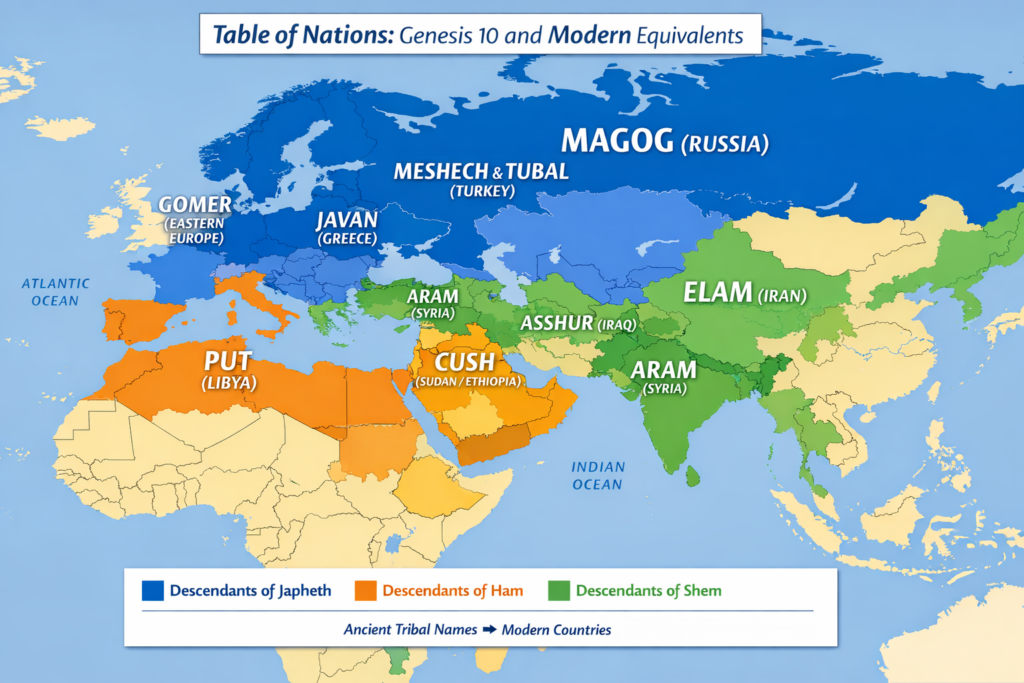
The ancient genealogies of Genesis 10 are not merely a record of the distant past — they are the very nations whose modern descendants may soon fulfill some of the most dramatic prophecies in all of Scripture. The prophet Ezekiel, writing under divine inspiration, described a future coalition of nations that would march against the land of Israel in the latter days: “And the word of the LORD came unto me, saying, Son of man, set thy face against Gog, the land of Magog, the chief prince of Meshech and Tubal, and prophesy against him” (Ezekiel 38:1–2, KJV). Modern Bible scholars widely identify Magog with Russia, Meshech and Tubal with Turkey, Persia with Iran, Cush with Sudan and Ethiopia, and Put with Libya — all nations whose hostility toward Israel is visible in today’s geopolitical headlines.
This coalition, described in Ezekiel 38:5–6 as including Persia, Ethiopia, Libya, Gomer, and Togarmah, will come against Israel “like a cloud to cover the land” (Ezekiel 38:9, KJV), driven by a desire to seize wealth and resources: “To take a spoil, and to take a prey” (Ezekiel 38:12, KJV). Yet God promises a supernatural and devastating response — “I will call for a sword against him throughout all my mountains, saith the Lord GOD: every man’s sword shall be against his brother. And I will plead against him with pestilence and with blood; and I will rain upon him, and upon his bands, and upon the many people that are with him, an overflowing rain, and great hailstones, fire, and brimstone” (Ezekiel 38:21–22, KJV). This battle is not isolated — it connects directly to the broader panorama of end-times war described in the book of Daniel, where a great king of the north pushes southward toward Israel: “And at the time of the end shall the king of the south push at him: and the king of the north shall come against him like a whirlwind, with chariots, and with horsemen, and with many ships” (Daniel 11:40, KJV).
The book of Revelation further unveils the full scope of end-times conflict, describing the gathering of the kings of the earth to the battle of Armageddon: “For they are the spirits of devils, working miracles, which go forth unto the kings of the earth and of the whole world, to gather them to the battle of that great day of God Almighty… And he gathered them together into a place called in the Hebrew tongue Armageddon” (Revelation 16:14–16, KJV).
The Psalmist also foresaw a confederacy of nations conspiring against Israel: “They have said, Come, and let us cut them off from being a nation; that the name of Israel may be no more in remembrance. For they have consulted together with one consent: they are confederate against thee — the tabernacles of Edom, and the Ishmaelites; of Moab, and the Hagarenes; Gebal, and Ammon, and Amalek; the Philistines with the inhabitants of Tyre; Assur also is joined with them” (Psalm 83:4–8, KJV) — a roster of ancient peoples whose modern equivalents span the Arab world and beyond. Even the prophet Joel described the final gathering of all nations into the valley of judgment: “I will also gather all nations, and will bring them down into the valley of Jehoshaphat, and will plead with them there for my people and for my heritage Israel” (Joel 3:2, KJV).
What makes all of this so extraordinary is that every nation named in these prophecies — Russia, Turkey, Iran, Libya, Sudan, the Arab confederacies — can be traced by name back to the Table of Nations in Genesis 10. The wars of the modern world are not random chaos; according to Scripture, they are the final movements of an ancient story that God himself set in motion, and he alone will bring to its appointed conclusion: “I will make myself known in the eyes of many nations, and they shall know that I am the LORD” (Ezekiel 38:23, KJV).
Scriptures Referenced:
- Ezekiel 38:1–2 · 38:5–6 · 38:9 · 38:12 · 38:21–22 · 38:23 (KJV)
- Daniel 11:40 (KJV)
- Psalm 83:4–8 (KJV)
- Joel 3:2 (KJV)
- Revelation 16:14–16 (KJV)
How to Read This Book: This interactive study is organized into 11 chapters. To begin reading, scroll down to the book below and use the chapter panel on the left side to jump to any topic — simply click a chapter title and the content will appear on the right. To read straight through from beginning to end, use the “Next” button at the bottom of each page to advance to the following chapter. Whether you’re exploring a specific topic or reading cover to cover, everything you need is right at your fingertips. ~ Enjoy your reading!
From Noah to Nations: A Biblical Study of Genesis 10 and the Origin of All Peoples
This study traces each ancient name to its modern equivalent, uncovers the stunning prophetic connections in Ezekiel 38–39, explores how the Tower of Babel explains the origin of the world’s languages, and reveals how Pentecost begins the great reversal of that ancient division. From Noah’s three sons to the nations of the last days — this is one of Scripture’s most profound and far-reaching passages, and it has never been more relevant than it is today.
From Noah to Nations
When most readers encounter genealogies in the Bible, they tend to skim past them. Lists of unfamiliar names seem dry and distant. Yet Genesis 10 is no ordinary genealogy. Ancient Near Eastern scholars, historians, and Bible students alike have called it the most remarkable ethnographic document of the ancient world — a text that attempts to explain the origin of every known nation from a single family.
The Table of Nations begins “after the flood.” Noah’s three sons — Shem, Ham, and Japheth — each became the patriarchs of major branches of humanity. The dispersion described in Genesis 10 is closely connected to the Tower of Babel in Genesis 11, which explains how and why this spreading happened so rapidly.
| Son of Noah | Direction | Major Regions | Ancient Peoples |
|---|---|---|---|
| Japheth | North & West | Europe, Anatolia, Central Asia | Greeks, Scythians, Medes, Thracians |
| Ham | South & Southwest | Africa, Canaan, Arabia | Egyptians, Nubians, Canaanites, Libyans |
| Shem | Middle East | Mesopotamia, Arabia, Persia | Hebrews, Assyrians, Arameans, Elamites |
When the names in Genesis 10 are counted in the original Hebrew text, scholars arrive at approximately 70 nations — a number that recurs throughout Scripture as a symbol of completeness and totality. From these 70 families, all of the civilizations of the ancient world emerged.
Japheth had seven sons, each becoming the patriarch of a distinct people group. Their descendants spread across Europe, Anatolia, and the northern regions of the ancient world. In New Testament times, these peoples were collectively known as “the Gentiles.”
| Biblical Name | Ancient People | Modern Region | Modern Countries |
|---|---|---|---|
| Gomer | Cimmerians | Eastern Europe / Turkey | Ukraine, Germany, Turkey |
| Magog | Scythians | Russian steppes / Central Asia | Russia, Ukraine, Kazakhstan |
| Madai | Medes | Northwestern Iran | Iran (ancient Media) |
| Javan | Ionians (Greeks) | Greece & Aegean islands | Greece |
| Tubal | Tabal kingdom | Eastern Anatolia | Eastern Turkey |
| Meshech | Mushki tribes | Caucasus / Anatolia | Turkey, Georgia |
| Tiras | Thracians | Balkans | Bulgaria, Romania, Greece |
| Name | Parent | Ancient Identification | Modern Area |
|---|---|---|---|
| Ashkenaz | Gomer | Germanic / Scythian tribes | Germany, Central/Eastern Europe |
| Riphath | Gomer | Paphlagonians | Northern Turkey (Black Sea) |
| Togarmah | Gomer | Armenian tribes | Armenia / Caucasus |
| Elishah | Javan | Aegean island peoples | Cyprus, Greek islands |
| Tarshish | Javan | Tartessos traders | Spain (southern Iberia) |
| Kittim | Javan | Cypriots | Cyprus |
| Dodanim | Javan | Rhodians | Rhodes, Aegean islands |
Ashkenaz is particularly fascinating — in medieval Jewish tradition, the name became associated with Germany and Central Europe. This is why Jews of Central/Eastern European descent are called “Ashkenazi Jews” — a term derived directly from this Genesis 10 name. Javan is the Hebrew word for Greece, still used in modern Hebrew today.
Ham was the father of four sons whose descendants spread south and southwest from the ancient Near East, populating Africa and the Mediterranean coastal lands. Ancient Egyptian texts themselves refer to Egypt as “the land of Ham,” and Psalm 105 uses this phrase as a direct synonym for Egypt.
| Biblical Name | Ancient People | Modern Region | Modern Countries |
|---|---|---|---|
| Cush | Nubians / Ethiopians | Nile Valley south of Egypt | Sudan, Ethiopia, Somalia |
| Mizraim | Egyptians | Nile Delta & Nile Valley | Egypt |
| Put | Libyans | North Africa west of Egypt | Libya, Tunisia |
| Canaan | Canaanites | Levant coast & inland | Israel, Lebanon, Palestine |
The most famous of Cush’s descendants was Nimrod, described in Genesis 10:8–10 as a “mighty hunter before the LORD” and the founder of the world’s first empire — including Babel, Erech, and Accad in Mesopotamia. Nimrod is the pivotal figure connecting Ham’s lineage directly to the Tower of Babel narrative in Genesis 11.
Mizraim is the Hebrew word for Egypt, still used in modern Hebrew and Arabic (Misr) today. Canaan’s sons included the Sidonians (Phoenicians), Hittites, Jebusites (who held Jerusalem), and Amorites — all peoples Israel encountered when entering the Promised Land.
Shem was Noah’s eldest son. His name means “name” or “renown” in Hebrew, and in Noah’s blessing, Shem receives special honor: “Blessed be the LORD God of Shem.” Shem’s descendants are known collectively as the “Semitic” peoples — covering the family of languages including Hebrew, Arabic, Aramaic, and Akkadian.
| Biblical Name | Ancient People | Modern Region | Modern Countries |
|---|---|---|---|
| Elam | Elamites | Southwestern Iran | Iran (Khuzestan) |
| Asshur | Assyrians | Northern Mesopotamia | Iraq, Syria |
| Arphaxad | Chaldeans / Hebrews | Southern Mesopotamia → Israel | Israel (via Abraham) |
| Lud | Lydians | Western Anatolia | Western Turkey |
| Aram | Arameans | Syria / Mesopotamia | Syria |
Through Arphaxad comes the line: Arphaxad → Shelah → Eber → Peleg → Reu → Serug → Nahor → Terah → Abraham. This is the lineage through which God would bring the Messiah into the world. The name “Hebrew” (Ivri) may derive directly from Eber, the great-grandson of Arphaxad.
| Language | Associated People | Modern Status |
|---|---|---|
| Hebrew | Israelites | Still spoken in Israel today |
| Arabic | Arabs | Spoken by 400+ million people |
| Aramaic | Arameans | Still spoken in some communities |
| Akkadian | Babylonians / Assyrians | Ancient (now extinct) |
| Amharic | Ethiopians | Official language of Ethiopia |
Genesis 11 opens with a startling statement: “And the whole earth was of one language, and of one speech.” The descendants of Noah migrated to the plain of Shinar (ancient Mesopotamia, modern Iraq) and made a fateful decision: to build a city and a tower rather than spread across the earth as God had commanded.
The structure was almost certainly a ziggurat — a massive stepped pyramid-shaped temple tower common in ancient Mesopotamia. The ruins of ancient Babylon preserve evidence of Etemenanki (“house of the foundation of heaven and earth”), a ziggurat that once rose to roughly 90 meters in height. Ancient clay tablets describe it as reaching “to the heavens.”
| Language Family | Example Languages | Connection to Noah |
|---|---|---|
| Indo-European | Greek, Latin, Persian, English | Japheth (Javan = Greek, Madai = Medes) |
| Semitic | Hebrew, Arabic, Aramaic | Shem (Aram, Asshur, Arphaxad) |
| Afro-Asiatic | Ancient Egyptian, Berber languages | Ham (Mizraim = Egypt, Put = Libya) |
Pentecost — celebrated fifty days after Passover — became the occasion for one of the most dramatic events in the New Testament. The disciples of Jesus, gathered in Jerusalem after his resurrection, suddenly experienced the promised outpouring of the Holy Spirit. The central miracle was the ability to speak in languages they had never learned.
| Nation at Pentecost (Acts 2) | Genesis 10 Connection |
|---|---|
| Parthians & Medes | Madai, son of Japheth |
| Elamites | Elam, son of Shem |
| Mesopotamia | Asshur & others (Shem) |
| Egypt | Mizraim, son of Ham |
| Libya | Put, son of Ham |
| Rome / Italy | Japheth’s line (Kittim) |
| Arabia | Shem’s descendants |
| Crete | Caphtorim (Ham / Mizraim) |
| Tower of Babel (Genesis 11) | Pentecost (Acts 2) |
|---|---|
| One language divided into many | Many languages heard as one message |
| People scattered from one place | People gathered from many places |
| Human pride seeking glory | God’s Spirit bringing humility |
| Division and confusion | Unity through the gospel |
Certain numbers carried established theological meanings for the biblical writers. The number 70 — seven multiplied by ten — carried the sense of complete fullness or totality. When the Bible uses 70, it signals the complete scope of something: all the nations, the full leadership of Israel, the total extent of God’s dealings with humanity.
| Event | Reference | Significance |
|---|---|---|
| 70 nations in Genesis | Genesis 10 | The complete scope of all humanity after the Flood |
| 70 family members in Egypt | Exodus 1:5 | Israel as a microcosm of the 70 nations |
| 70 elders of Israel | Numbers 11:16 | Complete leadership of God’s covenant people |
| 70 years Babylonian captivity | Jeremiah 25:11 | Complete period of national discipline |
| 70 weeks of Daniel’s prophecy | Daniel 9:24 | Complete scope of prophetic history |
| 70 disciples sent by Jesus | Luke 10:1 | Gospel sent symbolically to all 70 nations |
The most theologically significant occurrence in the New Testament is Luke 10:1, where Jesus appointed “other seventy also, and sent them two and two.” This is almost certainly a deliberate echo of the 70 nations of Genesis 10 — Jesus symbolically commissioning the global spread of the gospel to every nation in the Table of Nations.
The names in Ezekiel’s prophecy — Magog, Meshech, Tubal, Gomer, Togarmah — come directly from the Table of Nations in Genesis 10. Ezekiel was not inventing new names; he was using the ancestral names of peoples his audience would recognize as the great powers north and east of Israel. The biblical continuity is striking: Genesis 10 establishes the nations, Ezekiel 38–39 describes their future role.
| Biblical Name | Genesis 10 Origin | Ancient People | Modern Interpretation |
|---|---|---|---|
| Magog | Son of Japheth | Scythians north of Black Sea | Russia / Central Asia |
| Meshech | Son of Japheth | Mushki of Anatolia | Turkey / possibly Russia |
| Tubal | Son of Japheth | Tabal of eastern Anatolia | Turkey |
| Persia | — | Ancient Persia | Iran |
| Cush | Son of Ham | Nubians south of Egypt | Sudan / Ethiopia |
| Put | Son of Ham | Libyans west of Egypt | Libya |
| Gomer | Son of Japheth | Cimmerians / Europeans | Turkey / Eastern Europe |
| Togarmah | Son of Gomer | Armenians / Caucasus | Armenia / Turkey |
Ezekiel 38–39 describes a catastrophic defeat of the invading army — not by Israeli military power, but by direct divine intervention:
- A great earthquake shaking all the earth (38:19–20)
- Confusion and infighting among the coalition armies (38:21)
- Pestilence, overflowing rain, great hailstones, fire and brimstone (38:22)
- The bodies taking seven months to bury (39:12)
- The weapons burning as fuel for seven years (39:9)
| Name | Level | Identification | Modern Location |
|---|---|---|---|
| Gomer | Son | Cimmerians | Eastern Europe, Turkey |
| Ashkenaz | Gomer’s son | Germanic / Scythian tribes | Germany, Eastern Europe |
| Riphath | Gomer’s son | Paphlagonians | N. Turkey (Black Sea) |
| Togarmah | Gomer’s son | Armenians / Caucasus | Armenia, SE Turkey |
| Magog | Son | Scythians | Russia, Ukraine, C. Asia |
| Madai | Son | Medes | Northwestern Iran |
| Javan | Son | Ionians (Greeks) | Greece |
| Elishah | Javan’s son | Aegean / Alashiya | Cyprus, Greek islands |
| Tarshish | Javan’s son | Tartessos | Spain (southern) |
| Kittim | Javan’s son | Cypriots | Cyprus |
| Dodanim | Javan’s son | Rhodians | Rhodes, Aegean islands |
| Tubal | Son | Tabal kingdom | Eastern Turkey |
| Meshech | Son | Mushki tribes | Turkey / Caucasus |
| Tiras | Son | Thracians | Bulgaria, Romania |
| Name | Level | Identification | Modern Location |
|---|---|---|---|
| Cush | Son | Nubians / Ethiopians | Sudan, Ethiopia |
| Seba | Cush’s son | Sabaeans (upper Nile) | Sudan / Somalia |
| Havilah | Cush’s son | Arabian tribal group | W. Saudi Arabia |
| Sabtah | Cush’s son | Arabian coast peoples | Arabian Peninsula |
| Raamah | Cush’s son | SW Arabian tribes | Yemen region |
| Sabtechah | Cush’s son | SE Arabian peoples | SE Arabia |
| Sheba | Raamah’s son | Sabaean kingdom | Yemen |
| Dedan | Raamah’s son | NW Arabian tribe | NW Saudi Arabia |
| Nimrod | Cush’s son | First empire builder | Iraq / Mesopotamia |
| Mizraim | Son | Egyptians | Egypt |
| Ludim | Mizraim’s son | N. African Berber-related | Libya / N. Africa |
| Anamim | Mizraim’s son | Libyan tribe | Libya |
| Lehabim | Mizraim’s son | Libyans (Libu) | Libya |
| Naphtuhim | Mizraim’s son | Nile Delta peoples | N. Egypt |
| Pathrusim | Mizraim’s son | Upper Egyptians (Pathros) | S. Egypt |
| Casluhim | Mizraim’s son | Philistine ancestors | Gaza / Philistia |
| Caphtorim | Mizraim’s son | Cretans / Minoans | Crete |
| Put | Son | Libyans | Libya, Tunisia |
| Canaan | Son | Canaanites | Israel, Lebanon |
| Sidon | Canaan’s son | Phoenicians of Sidon | Lebanon |
| Heth | Canaan’s son | Hittites | C. Turkey / Canaan |
| Jebusite | Canaan’s son | Jebusites (Jerusalem) | Jerusalem |
| Amorite | Canaan’s son | Amorites (Amurru) | Syria, Jordan, Canaan |
| Girgasite | Canaan’s son | Girgashites of Canaan | Canaan |
| Hivite | Canaan’s son | Hivites of N. Canaan | Lebanon / N. Israel |
| Arkite | Canaan’s son | Arqa (N. Lebanon) | N. Lebanon |
| Sinite | Canaan’s son | Sin (near Arqa) | N. Lebanon |
| Arvadite | Canaan’s son | Arvad island | Syrian coast |
| Zemarite | Canaan’s son | Sumur coastal city | Syrian coast |
| Hamathite | Canaan’s son | Hamath city-state | Hama, Syria |
| Name | Level | Identification | Modern Location |
|---|---|---|---|
| Elam | Son | Elamites | SW Iran |
| Asshur | Son | Assyrians | N. Iraq, Syria |
| Arphaxad | Son | Chaldeans / Hebrew ancestors | S. Iraq → Israel |
| Shelah | Arphaxad’s son | Link to Eber | Mesopotamia |
| Eber | Shelah’s son | Hebrews (Ivri) | Ancestor of Israel |
| Peleg | Eber’s son | Division era (Babel) | Mesopotamia |
| Joktan | Eber’s son | South Arabian tribes | Arabia |
| Hazarmaveth | Joktan’s son | Hadramawt region | Yemen (Hadramaut) |
| Uzal | Joktan’s son | Sanaa (ancient capital) | Yemen (Sanaa) |
| Sheba | Joktan’s son | Sabaean kingdom | Yemen |
| Ophir | Joktan’s son | Famous gold-producing land | Disputed (Arabia/India/Africa) |
| Lud | Son | Lydians | W. Turkey |
| Aram | Son | Arameans | Syria |
| Uz | Aram’s son | Land of Uz (Job’s homeland) | N. Arabia / Syria |
| Hul | Aram’s son | Aramean tribe | Syria |
| Gether | Aram’s son | Mesopotamian tribe | Iraq / Syria |
| Mash | Aram’s son | Mashu (cedar mountain) | N. Syria / Lebanon |
| Family | Nations |
|---|---|
| Japheth | 14 |
| Ham | ~30 |
| Shem | ~26 |
| TOTAL | ~70 |
Modern archaeologists, linguists, and geneticists have progressively confirmed many of the general migrations described in Genesis 10. DNA studies reveal that the populations of the Middle East, Europe, and Africa have distinct genetic signatures that largely align with the three branches of Noah’s family.
| Modern Country | Genesis 10 Connection | Ancient People |
|---|---|---|
| Greece | Javan (son of Japheth) | Ionians |
| Iran (Persia) | Madai (son of Japheth) | Medes |
| Russia / Ukraine | Magog (son of Japheth) | Scythians |
| Turkey | Tubal, Meshech, Togarmah | Tabal, Mushki, Armenians |
| Germany / C. Europe | Ashkenaz (grandson) | Germanic tribes |
| Spain | Tarshish (grandson) | Tartessos traders |
| Armenia | Togarmah (grandson) | Armenian highlands peoples |
| Bulgaria / Romania | Tiras (son of Japheth) | Thracians |
| Modern Country | Genesis 10 Connection | Ancient People |
|---|---|---|
| Egypt | Mizraim (son of Ham) | Ancient Egyptians |
| Sudan / Ethiopia | Cush (son of Ham) | Nubians / Cushites |
| Libya / Tunisia | Put (son of Ham) | Ancient Libyans |
| Lebanon | Sidon (grandson of Ham) | Phoenicians |
| Israel / Palestine | Canaan (son of Ham) | Canaanites (original) |
| Iraq (Babel) | Nimrod via Cush | First Mesopotamian empire |
| Yemen | Sheba (Ham’s line) | Sabaean kingdom |
| Modern Country | Genesis 10 Connection | Ancient People |
|---|---|---|
| Israel | Arphaxad → Abraham → Israel | Hebrews |
| Iraq | Asshur (son of Shem) | Assyrians |
| Syria | Aram (son of Shem) | Arameans |
| Iran (part) | Elam (son of Shem) | Elamites |
| Turkey (west) | Lud (son of Shem) | Lydians |
| Yemen / S. Arabia | Joktan line (via Shem) | Ancient Arabian tribes |
Israel — the nation God chose as his covenant people — is geographically surrounded by descendants of all three sons of Noah. Egypt (Ham) to the southwest. Syria and Assyria (Shem) to the north and east. The Mediterranean world of Japheth to the northwest. Israel stands at the crossroads of three continents and three family lines — placed there, from a biblical perspective, as a “kingdom of priests” at the center of all nations.
The most important theological truth embedded in Genesis 10 is this: God is sovereign over the nations. The dispersion of humanity was not a chaotic accident. The apostle Paul made this point explicitly to Greek philosophers in Athens:
| Stage | Event | Significance for the Nations |
|---|---|---|
| Creation | God creates one humanity | All people share one origin |
| Flood | Judgment & preservation | New start for all nations |
| Genesis 10 | 70 nations formed | Nations established by God’s design |
| Genesis 11 | Babel — languages divided | Nations separated, still in God’s plan |
| Genesis 12 | Abraham called | Redemptive plan begins for all nations |
| Ezekiel 38–39 | Northern coalition prophecy | Nations in latter-day history |
| Luke 10 | 70 disciples sent | Gospel going to all 70 nations |
| Acts 2 | Pentecost | Babel reversed; nations drawn to God |
| Revelation 7 | Multitude from every nation | God’s plan for the nations completed |
The word “world” in John 3:16 encompasses all 70 nations of Genesis 10. The scope of God’s love is precisely as wide as the Table of Nations.
We began this journey with a genealogy — a list of names that most readers pass by without a second glance. We end it with a vision of all nations standing before the throne of God. The distance between those two points is the entire sweep of biblical history, and Genesis 10 is the map that connects them.
In these pages, we have traced the sons of Noah to the ancient civilizations they founded. We have followed Japheth’s descendants into Europe and Anatolia, Ham’s children into Africa and Canaan, and Shem’s line through the Middle East to Abraham, Israel, and ultimately to Jesus Christ.
We have seen how the Tower of Babel explains the division of languages and the scattering of nations — and how Pentecost begins the reversal of that division. We have observed how the number 70 threads through the Bible as God’s signature on his plan for all peoples. We have mapped the nations of Genesis 10 onto the modern world and discovered that the ancient names still echo in today’s headlines.
Every “kindred, tongue, people, and nation” in that verse has a name in Genesis 10. The story that begins with Noah’s three sons ends with a redeemed multitude beyond counting, drawn from every branch of the great family tree of humanity.
That is the story of Genesis 10. And it is, ultimately, the story of a God who loves the world enough to pursue every nation — from Babel to the ends of the earth — and will not stop until every people has heard his name.
“Genesis 10 Table of Nations”
“And when ye shall see Jerusalem compassed with armies, then know that the desolation thereof is nigh.“ – Luke 21:20
People get ready because Jesus is on his way back after all things are fulfilled, and all peoples, nations, and tongues will stand before the Lord to give an account to the Lord on the day of judgement.
“After this I beheld, and, lo, a great multitude, which no man could number, of all nations, and kindreds, and people, and tongues, stood before the throne, and before the Lamb, clothed with white robes, and palms in their hands;” – Revelation 7:9