The Judgment Seat of Christ: Understanding the Bēma of 2 Corinthians 5:10
By Pastor Joel – Open Heaven Christian Church – Fisher, Arkansas
“For we must all appear before the judgment seat of Christ, so that each one may receive what is due for what he has done in the body, whether good or evil.” — 2 Corinthians 5:10
Few verses capture both the solemnity and hope of Christian accountability like 2 Corinthians 5:10. At the center of Paul’s statement is one powerful Greek word: βῆμα (bēma).
Understanding bēma unlocks the depth of what Paul is teaching about the believer’s future encounter with Christ.
What Does Bēma Mean?
Original Word: βῆμα (bēma)
Pronunciation: BAY-mah
Part of Speech: Noun, Neuter
Word Origin: From the same base as basis (βάσις – “foot”), meaning something stepped upon.
Lexical Summary
- A step, a foot-breadth
- A raised platform
- A rostrum (public speaking platform)
- A tribunal (seat of judgment)
- A judgment seat or throne
Strong’s Concordance #968 describes bēma as:
A step; by implication a rostrum; a tribunal — judgment-seat, throne.
HELPS Word Studies adds:
A platform to which someone walked up to receive judgment; figuratively, the administration of justice — from a tribunal-chair where rewards and punishments are given.
The Physical Picture Behind the Word
The bēma was not an abstract idea. In ancient Greek and Roman cities, it was a literal elevated platform.
- A Step or Raised Place
At its most basic meaning, bēma referred to something stepped upon — a raised place above the crowd. - A Public Platform (Rostrum)
Leaders and orators stood on the bēma to address the people. - A Tribunal of Authority
Most importantly, it was where magistrates sat to render decisions. From this platform, verdicts were issued and rewards distributed.
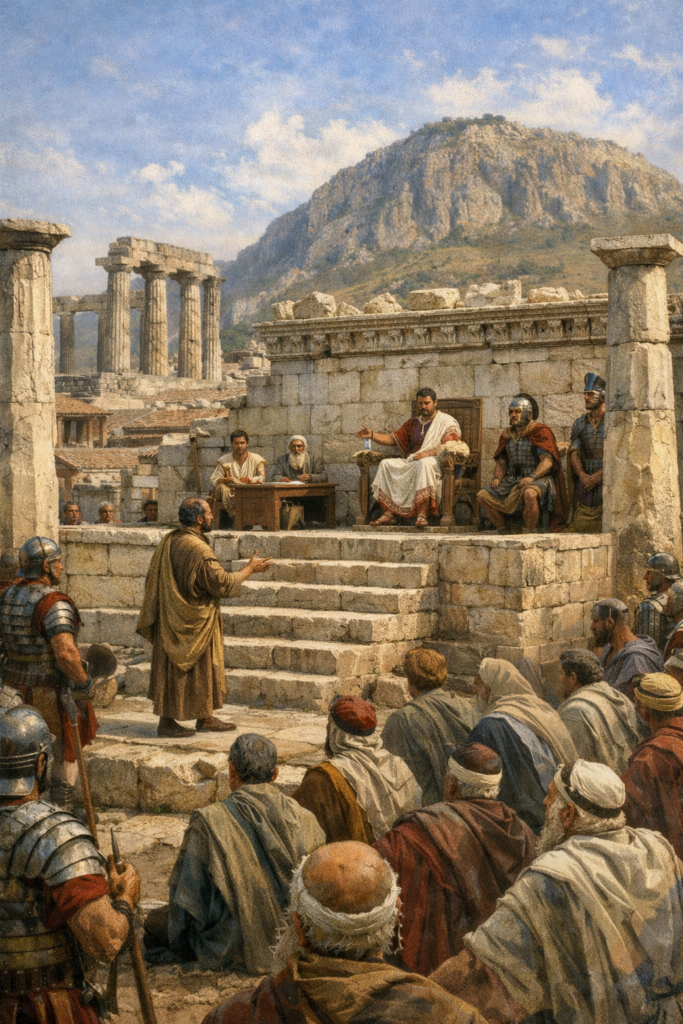
In the city of Corinth—where Paul wrote this letter—a prominent bēma stood in the marketplace. The Corinthians would immediately picture a raised stone tribunal where judgments were publicly declared.
What Paul Is — and Is Not — Saying
When Paul writes, “We must all appear before the judgment seat (bēma) of Christ,” he is not describing the Great White Throne judgment of final condemnation. Instead, he is speaking of a believer’s evaluation before Christ.
Let’s unpack the key elements.
1. “We Must All Appear”
The phrase implies:
- No exceptions
- No hiding
- No anonymity
The Greek verb carries the sense of being made manifest — fully revealed. At the bēma, everything is brought into the light.
This is not about losing salvation.
It is about revealing stewardship.
2. A Platform of Reward and Assessment
The word bēma strongly suggests evaluation, not merely sentencing.
In the Greco-Roman world:
- Athletes stood before the bēma to receive crowns.
- Citizens stood before the tribunal to answer for conduct.
- Rewards and consequences were distributed publicly.
Paul likely draws from both civic and athletic imagery. Believers are not standing trial for eternal destiny — that was settled at the cross — but for faithfulness in service.
3. “What He Has Done in the Body”
Paul emphasizes personal responsibility:
- Actions
- Motives
- Stewardship
- Faithfulness
The phrase “whether good or evil” does not refer to moral condemnation for sin already forgiven, but to what is worthwhile versus worthless.
Elsewhere Paul explains that some works endure like gold, while others burn like straw. The bēma reveals the true substance of our lives.
The Theological Weight of the Bēma
1. It Affirms Christ’s Authority
The bēma was a symbol of governmental authority. By calling it the judgment seat of Christ, Paul affirms that Jesus is the rightful Judge.
He is not merely Savior.
He is Lord.
2. It Emphasizes Accountability
Grace does not eliminate responsibility.
The believer’s life matters.
Our obedience matters.
Our motives matter.
The bēma reminds us that eternity evaluates time.
3. It Motivates Faithful Living
In the immediate context of 2 Corinthians 5, Paul speaks about:
- Pleasing the Lord
- Walking by faith
- Being absent from the body and present with the Lord
The coming bēma fuels present devotion. It is not meant to terrify believers, but to focus them.
The Imagery of Stepping Up
Remember the root meaning: a step.
The word comes from the concept of stepping upward onto a platform.
One day, every believer will “step up” before Christ.
Not to determine salvation.
But to evaluate a life.
It is deeply personal.
It is just.
It is righteous.
And it is presided over by the One who died for us.
What the Bēma Means for Us Today
- Live intentionally.
- Serve faithfully.
- Check your motives.
- Remember that unseen faithfulness is seen by Christ.
- Let eternity shape your daily decisions.
The bēma is not a threat hanging over the believer — it is a solemn reminder that our lives echo beyond the grave.
Final Reflection
The Greek word bēma paints a vivid picture: a raised tribunal where justice is administered and rewards are distributed. In 2 Corinthians 5:10, Paul invites us to live in light of that coming moment.
We (believers in Christ) will all stand before Christ.
Our works will be revealed, weather they were good or not.
And the One who judges us is the same One who redeemed us – Jesus.
That reality does not produce fear for the believer — it produces faithfulness.
Because the steps we take now determine what happens when we step onto the platform then.
Believers in Christ that have made it to heaven will all stand before the Lord Jesus Christ, and will be judged on the basis of all their earthly works they did while on earth. The works of a believer will not save them because believers are saved by the grace of God and their faith in Jesus. The works they have done on earth will be judged by the Lord and their rewards and crowns awarded – (See Crown Rewards Below) will be based on all their earthly endeavors in serving in the kingdom of God.
“And, behold, I come quickly; and my reward iswith me, to give every man according as his work shall be.” — Revelation 22:12
Jesus Christ will be the one sitting on His throne as the judge in the tribunal courts of heaven.
“I charge theetherefore before God, and the Lord Jesus Christ, who shall judge the quick and the dead at his appearing and his kingdom.” — 2 Timothy 4:1
THE FIVE AWARDED CROWNS
The Bible describes five distinct, symbolic crowns—or, in the Greek, stephanos (wreaths of honor)—that serve as heavenly rewards for believers, often linked to faithfulness at the Judgment Seat of Christ.
The five crowns are the Incorruptible Crown, Crown of Righteousness, Crown of Life, Crown of Rejoicing, and Crown of Glory.
The Incorruptible Crown (1 Corinthians 9:25): Awarded for self-discipline, mastering the flesh, and running the Christian race with endurance.
The Crown of Righteousness (2 Timothy 4:8): Promised to those who love and eagerly await the return of Jesus Christ.
The Crown of Life (James 1:12; Revelation 2:10): Given to those who endure suffering, trials, and persecution for their faith.
The Crown of Rejoicing (1 Thessalonians 2:19): Often called the “soul-winner’s crown,” it is for those who bring others to Christ.
The Crown of Glory (1 Peter 5:4): Awarded to faithful apostles, prophets, evangelist, pastors, teachers, elders, deacons, missionaries, helps ministries, and leaders who shepherd God’s people with care.
The awarded crowns highlight the significance of Christian service and are ultimately cast at the feet of Jesus in worship, as the 24 elders did in Revelation 4:10-11
Below is an earthly image of what the Trial of the Apostle Paul may have looked like when he stood trial in the city of Corinth during the 1st century AD. This image depicts a picture of what the Bema Seat of Christ may look like on the day of judgment for all believers.