Did fallen angels become demons or they in a different class of their own?
By Pastor Joel – Open Heaven Christian Church – Fisher, Arkansas
From a biblical perspective, the safest answer is: the Bible does not explicitly say that fallen angels and demons are two completely separate classes of beings. However, there are some important distinctions in the biblical passages that have led Christians to different conclusions.
1. Fallen angels
The Bible clearly teaches that some angels rebelled against God.
2 Peter 2:4 (KJV):
“For if God spared not the angels that sinned, but cast them down to hell, and delivered them into chains of darkness, to be reserved unto judgment…”
Jude 6 (KJV) similarly speaks of:
“the angels which kept not their first estate, but left their own habitation…”
These beings are explicitly called angels who sinned and are awaiting judgment.
2. Demons / devils
The New Testament frequently describes devils (Greek daimonion) as evil spiritual beings that possess and oppress people.
For example:
Mark 5:9 (KJV):
“And he asked him, What is thy name? And he answered, saying, My name is Legion: for we are many.”
Jesus repeatedly cast these spirits out of people.
But here’s the important point:
The Bible never directly says, “Demons are fallen angels.”
That identification became very common in Christian theology, but it is an inference rather than a sentence explicitly stated in Scripture.
3. There is an interesting distinction in 2 Peter and Jude
This is where the question gets particularly interesting.
Some fallen angels are described as being imprisoned:
2 Peter 2:4 — angels that sinned are in “chains of darkness.”
Jude 6 — angels that left their proper habitation are “reserved unto the judgment of the great day.”
Yet during Jesus’ earthly ministry, demons appear to be free and active.
They recognize Jesus and understand that judgment is coming.
Matthew 8:29 (KJV):
“Art thou come hither to torment us before the time?”
That raises a legitimate biblical question:
If every demon is simply a fallen angel, why are some rebellious angels already imprisoned while other evil spirits are apparently free?
There isn’t enough explicit Scripture to answer that definitively.
4. The Book of Revelation adds another piece
Satan is described as a fallen angelic being:
Revelation 12:9 (KJV):
“And the great dragon was cast out, that old serpent, called the Devil, and Satan…”
And it says:
“he was cast out into the earth, and his angels were cast out with him.”
Notice the wording: “his angels.”
So Satan unquestionably has angelic beings associated with him.
5. What about the “sons of God” in Genesis 6?
This is where the subject becomes much more controversial.
Genesis 6:1–4 describes the “sons of God” taking wives of the daughters of men and mentions the Nephilim.
There are several major interpretations:
Angelic interpretation: the “sons of God” were rebellious heavenly beings.
Sethite interpretation: they were descendants of Seth who intermarried with Cain’s descendants.
Royal/ruler interpretation: they were powerful human rulers.
The first interpretation became particularly influential in ancient Jewish literature, including 1 Enoch, but 1 Enoch is not part of the Protestant biblical canon.
Interestingly, Jude’s reference to angels leaving their “first estate” has sometimes been connected with Genesis 6.
So are demons fallen angels?
I’d put it this way:
Being | Explicitly identified in Scripture? | What Scripture says |
|---|---|---|
Angels | Yes | Created heavenly beings who serve God |
Fallen angels | Yes | Angels who sinned/rebelled against God |
Satan | Yes | The Devil, the adversary, associated with fallen angels |
Demons/devils | Yes | Evil spiritual beings who possess/afflict people |
Demons = fallen angels | Not explicitly | Common theological conclusion, but not directly stated |
All fallen angels are demons | Not explicitly | Some fallen angels are described as imprisoned |
My conclusion from Scripture
I would not teach as an absolute biblical fact that:
“Fallen angels became demons.”
The Bible doesn’t actually make that statement.
A more careful biblical position is:
There are rebellious/fallen angels, and there are evil spirits called devils/demons. They are clearly part of the kingdom of darkness under Satan, but Scripture does not explicitly define whether demons are fallen angels, a subset of fallen angels, or a distinct class of evil spirits.
And there is an even deeper question here: why does the Bible describe some rebellious angels as imprisoned while demons are apparently roaming the earth? That distinction may be important to understanding the spiritual hierarchy described in Scripture.
Biblical Hierarchy of Fallen Spiritual Powers
In order to understand the hierarchy within the kingdom of darkness, first we must understand that Satan does have a kingdom. In Matthew 12:26 Jesus clealy states that Satan has a kingdom.
Matthew 12:26 (KJV):
“And if Satan cast out Satan, he is divided against himself; how shall then his kingdom stand?”
The hierarchy of of fallen spiritual powers images below…
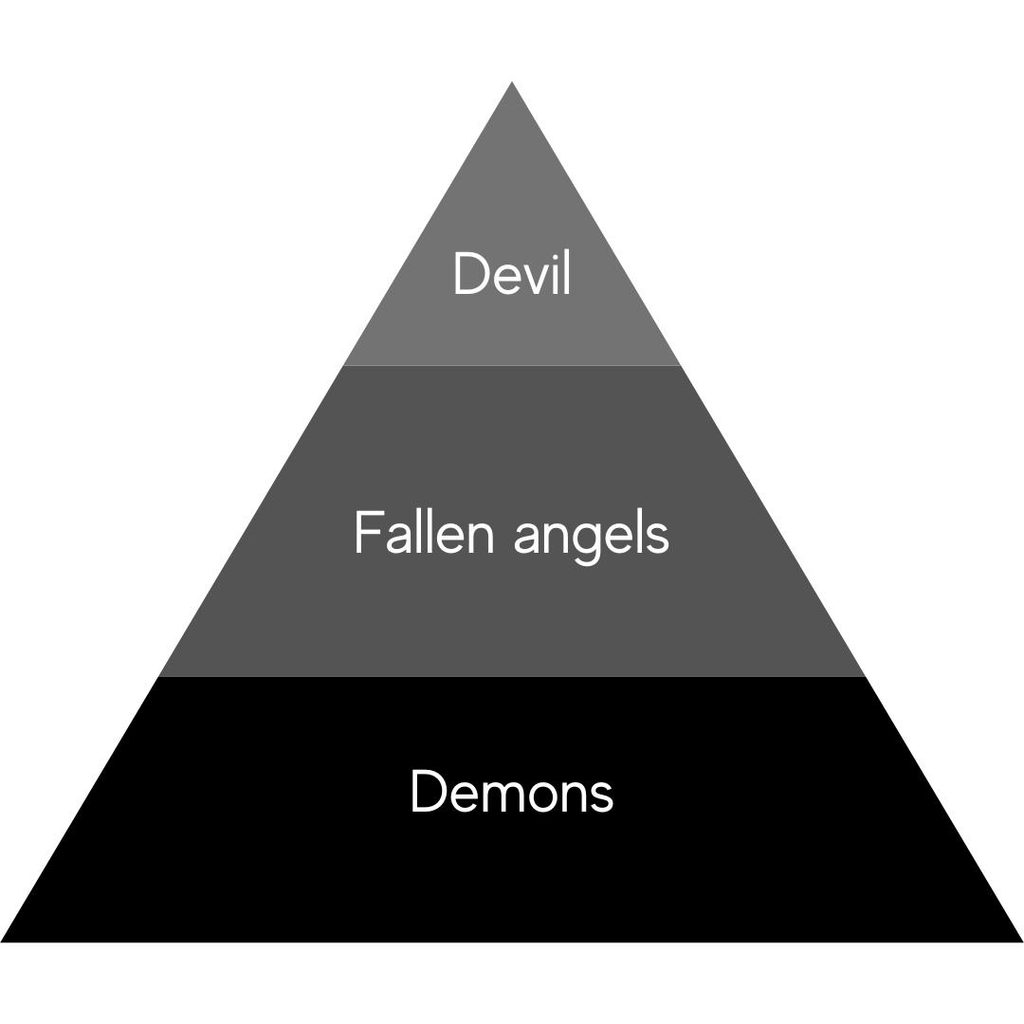
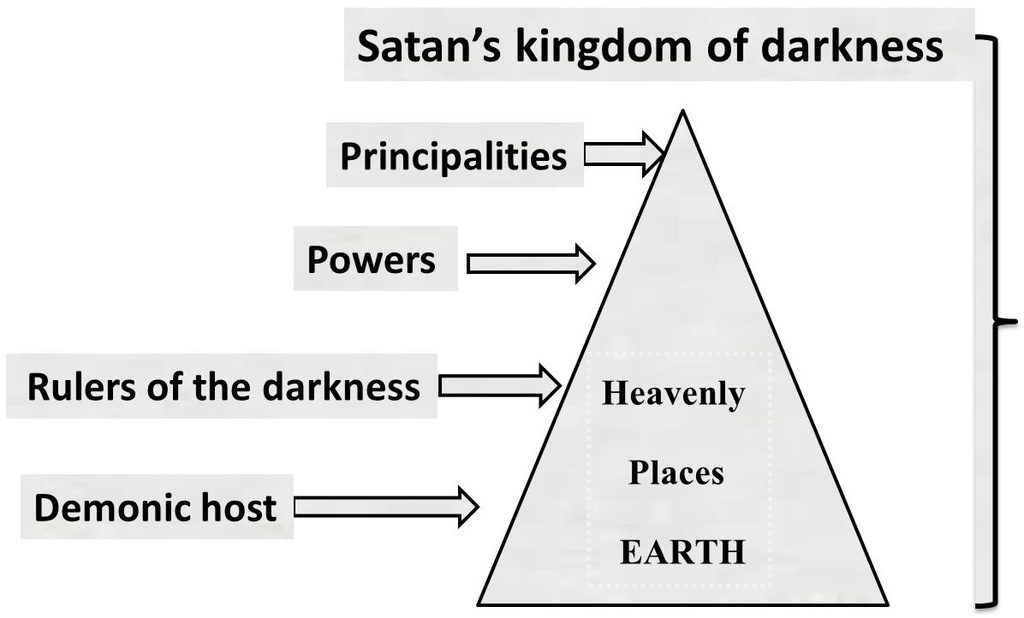
1. Satan — the chief adversary
At the top of the rebellious spiritual kingdom is Satan, also called:
The Devil
The Serpent
The Dragon
The Adversary
The Tempter
The Wicked One
Revelation 12:9 (KJV):
“And the great dragon was cast out, that old serpent, called the Devil, and Satan…”
Satan appears to exercise authority over other rebellious spiritual beings.
Matthew 12:24 (KJV):
“…Beelzebub the prince of the devils.”
Jesus then refers to Satan as the ruler of this kingdom:
Matthew 12:26 (KJV):
“And if Satan cast out Satan, he is divided against himself; how shall then his kingdom stand?”
So Scripture presents Satan as the head of a kingdom of darkness.
2. Fallen angels associated with Satan
Revelation gives us one of the clearest descriptions:
Revelation 12:7–9 (KJV):
“And there was war in heaven: Michael and his angels fought against the dragon; and the dragon fought and his angels…”
This establishes that Satan has “his angels.”
Then:
“And the great dragon was cast out… and his angels were cast out with him.”
Therefore, we can biblically establish:
Satan → his angels
These are unquestionably associated with Satan’s rebellion.
However, Scripture doesn’t give us the names or individual ranks of all these fallen angels.
3. Principalities
This is where Paul’s terminology becomes important.
Ephesians 6:12 (KJV):
“For we wrestle not against flesh and blood, but against principalities, against powers, against the rulers of the darkness of this world, against **spiritual wickedness in high places.”
Paul identifies several categories of spiritual opposition.
The Greek terms indicate different expressions of spiritual authority, although Scripture doesn’t provide a formal organizational chart explaining exactly how each rank relates to the others.
A reasonable biblical hierarchy is:
Principalities
↓
Powers
↓
Rulers of the darkness of this world
↓
Spiritual wickedness in high places
But we should not claim that Paul explicitly says these are four sequential ranks. He lists categories of spiritual enemies; the precise ranking is an interpretation.
4. Powers
The word translated “powers” is another category of spiritual opposition.
Paul uses similar language elsewhere.
Ephesians 1:20–21 (KJV) describes Christ as being:
“far above all principality, and power, and might, and dominion…”
That’s extremely important.
The same vocabulary used for spiritual authorities is used when describing Christ’s superiority over them.
Christ is therefore above every spiritual authority, whether good or evil.
5. Rulers of the darkness of this world
Ephesians 6:12 specifically identifies:
“the rulers of the darkness of this world”
These are presented as spiritual enemies involved in the present world system of darkness.
This should not automatically be interpreted as human political rulers.
Paul begins the verse by saying:
“we wrestle not against flesh and blood”
and then identifies the opposing forces as spiritual.
6. Spiritual wickedness in high places
The final category Paul mentions is:
“spiritual wickedness in high places.”
The phrase refers to spiritual wickedness in the heavenly/spiritual realm.
This is why Christian spiritual warfare isn’t fundamentally against people.
Paul’s point is that there is an invisible spiritual conflict behind the visible world.
7. Demons / devils
Then we have the beings the KJV generally calls “devils.”
The Greek word is daimonion.
These beings appear throughout the Gospels.
They can:
possess people
speak through possessed individuals
recognize Jesus
recognize His authority
cause physical affliction
obey Satan’s kingdom
fear future judgment
For example:
Mark 1:34 (KJV):
“And he healed many that were sick of divers diseases, and cast out many devils…”
And:
Luke 10:17 (KJV):
“Lord, even the devils are subject unto us through thy name.”
This demonstrates that demons operate under a spiritual authority structure.
8. Imprisoned fallen angels
This is an especially interesting category.
Not every rebellious spiritual being is apparently free to operate.
2 Peter 2:4 (KJV):
“For if God spared not the angels that sinned, but cast them down to hell, and delivered them into chains of darkness, to be reserved unto judgment…”
And Jude says:
Jude 6 (KJV):
“And the angels which kept not their first estate, but left their own habitation, he hath reserved in everlasting chains under darkness unto the judgment of the great day.”
So we have a group of fallen angels currently imprisoned.
This is one reason I would be cautious about saying:
“Every fallen angel is a demon.”
Scripture doesn’t establish that.
The Biblical Picture
Putting the information together, we can create a cautious biblical model:
Important: The diagram above is a theological model based on Scripture, not an organizational chart that the Bible itself explicitly lays out.
But There’s Another Major Biblical Hierarchy
The Bible also gives us the holy angelic hierarchy, which helps us understand the contrast.
We encounter:
Michael — archangel
Jude 9 (KJV):
“Yet Michael the archangel…”
Angels
Numerous passages refer simply to angels.
Cherubim
Cherubim appear prominently in Scripture.
Genesis 3:24 (KJV):
“So he drove out the man; and he placed at the east of the garden of Eden Cherubims, and a flaming sword…”
Seraphim
Isaiah describes seraphim around God’s throne.
Isaiah 6:2 (KJV):
“Above it stood the seraphims…”
Interestingly, the Bible does not tell us that Satan is simply an ordinary angel who became the commander of all fallen angels. There are clues suggesting that Satan had a significant position before his fall, but we should distinguish Scripture from later traditions.
What About Lucifer?
This is another area where there is a lot of misunderstanding.
The famous passage is:
Isaiah 14:12 (KJV):
“How art thou fallen from heaven, O Lucifer, son of the morning!”
The Hebrew expression is Helel ben Shachar, often rendered “Lucifer” in the Latin tradition.
But the immediate context of Isaiah 14 is explicitly a “proverb against the king of Babylon” (Isaiah 14:4).
Consequently, we shouldn’t simply state that Isaiah 14 is unquestionably giving Satan’s biography.
There is a similar issue with Ezekiel 28, which addresses the king of Tyrus while using extraordinarily exalted imagery.
These passages have traditionally been applied to Satan’s fall, but the immediate historical contexts must be acknowledged.
The Most Certain Biblical Hierarchy
If we separate certainty from interpretation, I’d organize it this way:
CERTAIN FROM SCRIPTURE
God
↓
Christ — supreme over all spiritual powers
↓
Satan — leader of the kingdom of darkness
↓
Satan’s angels / rebellious angels
↓
Demons/devils and other spiritual enemies
↓
Spiritual opposition against humanity
And separately:
Fallen angels who are currently imprisoned
↓
Awaiting God’s judgment
PROBABLE / THEOLOGICAL INFERENCE
Within Satan’s kingdom, there appear to be different levels or categories of spiritual authority:
Principalities → Powers → Rulers → Spiritual Wickedness
But Scripture doesn’t give us enough information to confidently assign every demon or fallen angel to a specific rank.
And there’s one more fascinating passage
Daniel 10 gives perhaps the most intriguing glimpse into an apparent spiritual governmental hierarchy.
Daniel encounters:
a heavenly messenger
the “prince of the kingdom of Persia”
Michael, described as one of the chief princes
the “prince of Grecia”
For example:
Daniel 10:13 (KJV):
“But the prince of the kingdom of Persia withstood me one and twenty days: but, lo, Michael, one of the chief princes, came to help me…”
This is fascinating because the “prince of Persia” appears to be a spiritual power associated with a geographic kingdom, rather than merely the human Persian king.
That passage, combined with Ephesians 6:12, is one of the strongest biblical foundations for the idea that the fallen spiritual realm has organized levels of authority.
The Biblical Spiritual Government
The clearest way to understand the biblical picture is to put Daniel 10, Ephesians 6, Revelation 12, Colossians 1, Hebrews 1, Jude, 2 Peter, Isaiah 6, and Ezekiel 10 together.
The overall picture is not that Satan has a kingdom equal to God’s. God’s kingdom is absolute; Satan’s kingdom is rebellious, temporary, and ultimately doomed.
I. THE HIGHEST AUTHORITY — GOD
At the very top there is no competing spiritual authority.
Deuteronomy 6:4 (KJV):
“Hear, O Israel: The LORD our God is one LORD”
God created the entire heavenly realm.
Colossians 1:16 (KJV):
“For by him were all things created, that are in heaven, and that are in earth, visible and invisible…”
Notice the words:
“whether they be thrones, or dominions, or principalities, or powers”
That is extremely important because Paul explicitly acknowledges different forms of authority in the invisible creation.
II. JESUS CHRIST — ABOVE EVERY SPIRITUAL POWER
Jesus Christ is not merely another spiritual authority.
He is above them all.
Ephesians 1:20–21 (KJV):
“…and set him at his own right hand in the heavenly places,
Far above all principality, and power, and might, and dominion, and every name that is named…”
Therefore:
Christ’s authority is far above Satan and every fallen spiritual power.
III. THE HOLY ANGELIC REALM
Before examining the rebellious kingdom, we need to understand the heavenly host.
Scripture describes several classes or descriptions of heavenly beings.
1. Seraphim
Isaiah 6:2 (KJV):
“Above it stood the seraphims: each one had six wings…”
They surround the throne of God and proclaim His holiness.
Isaiah 6:3:
“Holy, holy, holy, is the LORD of hosts…”
Seraphim are therefore associated directly with God’s throne and worship.
2. Cherubim
Cherubim are another extraordinary class of heavenly beings.
Ezekiel 10:20 (KJV):
“This is the living creature that I saw under the God of Israel by the river of Chebar; and I knew that they were the cherubims.”
Cherubim are associated with God’s glory and throne.
The Ark of the Covenant provides another picture.
Exodus 25:22 (KJV):
“And there I will meet with thee, and I will commune with thee from above the mercy seat, from between the two cherubims…”
So we can confidently associate cherubim with God’s throne/glory and divine presence.
3. Michael — Archangel
Michael receives a particularly interesting designation.
Jude 9 (KJV):
“Yet Michael the archangel…”
Michael is also described as a chief prince.
Daniel 10:13 (KJV):
“…but, lo, Michael, one of the chief princes, came to help me…”
And:
Daniel 12:1 (KJV):
“And at that time shall Michael stand up, the great prince which standeth for the children of thy people…”
Michael is therefore associated with angelic warfare and protection.
IV. SATAN — HEAD OF THE REBELLIOUS KINGDOM
Now we come to the opposing kingdom.
Scripture identifies Satan as:
Devil
Satan
Dragon
Serpent
Adversary
Revelation 12:9 (KJV):
“And the great dragon was cast out, that old serpent, called the Devil, and Satan…”
Most importantly, Revelation says:
“and his angels were cast out with him.”
That gives us a very important biblical relationship:
We cannot prove from Revelation alone that every one of Satan’s angels has a particular rank, but it clearly depicts Satan exercising leadership over rebellious angels.
V. THE FOUR CATEGORIES OF EPHESIANS 6:12
This is probably the most important passage for constructing a biblical model of spiritual government.
Ephesians 6:12 (KJV):
“For we wrestle not against flesh and blood, but against principalities, against powers, against the rulers of the darkness of this world, against spiritual wickedness in high places.”
Paul gives us four categories.
1. Principalities
Greek: archē
The basic idea involves rulers, authorities, or governing powers.
2. Powers
Greek: exousia
This carries the idea of authority.
3. Rulers of the darkness
These are described as ruling over the darkness of this world.
4. Spiritual wickedness in high places
This identifies evil spiritual forces operating in the heavenly/spiritual realm.
A useful conceptual model is:
But this is a model, not an explicit biblical organizational chart.
Paul does not say, “First rank, second rank, third rank, fourth rank.”
He identifies four categories of spiritual enemies.
VI. DANIEL 10 — THE MOST IMPORTANT EVIDENCE FOR “TERRITORIAL” SPIRITUAL POWERS
This is where the subject becomes particularly fascinating.
Daniel 10 describes an angelic messenger who was delayed.
Daniel 10:13 (KJV):
“But the prince of the kingdom of Persia withstood me one and twenty days…”
This is not easily understood as merely a human Persian ruler.
Why?
Because Michael comes to fight alongside the messenger:
“but, lo, Michael, one of the chief princes, came to help me…”
Then the messenger says:
Daniel 10:20 (KJV):
“…and now will I return to fight with the prince of Persia: and when I am gone forth, lo, the prince of Grecia shall come.”
We therefore see:
This is the strongest biblical basis for what modern Christians sometimes call territorial spirits.
But there’s an important qualification:
Scripture never uses the phrase “territorial spirit.”
That’s theological terminology derived primarily from passages such as Daniel 10.
What Scripture actually gives us is:
“prince of the kingdom of Persia”
and
“prince of Grecia.”
Those descriptions strongly suggest spiritual beings associated with earthly kingdoms, but we should avoid claiming more than the text says.
VII. DANIEL 10 REVEALS A SPIRITUAL CONFLICT BEHIND EARTHLY KINGDOMS
This is one of the most profound concepts in the Bible.
Daniel sees earthly political kingdoms, but behind them appears to be a spiritual conflict.
Persia has a spiritual “prince.”
Greece has a spiritual “prince.”
Michael is involved in the conflict.
Therefore:
This doesn’t mean every earthly government is controlled by a demon.
Rather, Daniel demonstrates that spiritual powers can be associated with earthly kingdoms and participate in spiritual conflict concerning them.
VIII. DEMONS / DEVILS
Now we come to the beings Jesus frequently encountered.
The KJV calls them devils.
For example:
Mark 5:8 (KJV):
“For he said unto him, Come out of the man, thou unclean spirit.”
And:
Mark 5:13:
“And forthwith Jesus gave them leave. And the unclean spirits went out…”
Notice the terminology:
devils = unclean spirits
They can:
possess people
speak
recognize Jesus
recognize Jesus’ authority
obey Christ’s commands
cause affliction
fear future judgment
IX. DEMONS RECOGNIZE THEIR FUTURE JUDGMENT
This is important because demons aren’t portrayed as independent gods.
Matthew 8:29 (KJV):
“Art thou come hither to torment us before the time?”
They understand there is a predetermined “time” of judgment.
This demonstrates something fundamental:
Satan’s kingdom is temporary.
X. THE LEGION — MANY DEMONS UNDER ONE COLLECTIVE IDENTITY
In Mark 5, Jesus encounters a particularly large demonic presence.
Mark 5:9 (KJV):
“What is thy name? And he answered, saying, My name is Legion: for we are many.”
That gives us another glimpse into collective demonic organization.
But we still aren’t told exactly where “Legion” fits within Paul’s categories.
XI. IMPRISONED FALLEN ANGELS
This is the category that prevents us from simply equating all demons with all fallen angels.
2 Peter 2:4 (KJV):
“For if God spared not the angels that sinned, but cast them down to hell, and delivered them into chains of darkness, to be reserved unto judgment…”
Jude says:
Jude 6 (KJV):
“And the angels which kept not their first estate, but left their own habitation, he hath reserved in everlasting chains under darkness unto the judgment of the great day.”
Therefore:
The Bible does not explicitly explain why some rebellious angels are imprisoned while other evil spirits remain active.
That’s an unresolved biblical question.
XII. THE ABYSS
There is another category that deserves attention.
Some evil spirits apparently fear being sent into the deep/abyss.
Luke 8:31 (KJV):
“And they besought him that he would not command them to go out into the deep.”
The Greek term is abyssos.
Revelation also describes an angel having the key to the bottomless pit.
Revelation 9:11 (KJV):
“And they had a king over them, which is the angel of the bottomless pit, whose name in the Hebrew tongue is Abaddon, but in the Greek tongue hath his name Apollyon.”
This introduces another fascinating figure: Abaddon/Apollyon.
However, Scripture does not explicitly identify him as Satan.
So we shouldn’t automatically make that identification.
XIII. THE SPIRITUAL GOVERNMENT — FULL MODEL
Putting the major passages together, here’s the most comprehensive biblical model I would use:
XIV. WHERE DOES MICHAEL FIT?
Michael is particularly interesting because Scripture calls him both:
“Michael the archangel” — Jude 9
and
“one of the chief princes” — Daniel 10:13.
He fights against Satan.
Revelation 12:7 (KJV):
“And there was war in heaven: Michael and his angels fought against the dragon…”
So:
This is one of the clearest examples of angelic warfare in Scripture.
XV. CHRIST’S AUTHORITY OVER ALL OF IT
And this is ultimately the most important part.
Jesus isn’t merely another combatant in this spiritual hierarchy.
He is above it.
Colossians 2:15 (KJV):
“And having spoiled principalities and powers, he made a shew of them openly, triumphing over them in it.”
That is extraordinarily powerful.
Paul says Christ triumphed over principalities and powers.
And:
1 Peter 3:22 (KJV):
“Who is gone into heaven, and is on the right hand of God; angels and authorities and powers being made subject unto him.”
Therefore the ultimate hierarchy is:
But the entire rebellious structure exists under God’s ultimate sovereignty and is destined for judgment.
XVI. THE FINAL DESTINY OF THE REBELLIOUS KINGDOM
Satan doesn’t win.
Revelation 20:10 (KJV):
“And the devil that deceived them was cast into the lake of fire and brimstone…”
Jesus also spoke about the ultimate destination prepared for the Devil and his angels.
Matthew 25:41 (KJV):
“Depart from me, ye cursed, into everlasting fire, prepared for the devil and his angels.”
So the final picture is:
The Key Distinction
There are three things I would not teach as established biblical facts:
“Every fallen angel is a demon.”
Scripture doesn’t explicitly say this.“Every demon is a fallen angel.”
Again, Scripture doesn’t explicitly say this.“Ephesians 6 gives us a four-level organizational ranking.”
Paul gives four categories of spiritual enemies, but doesn’t explicitly number them as ranks.
What Scripture does establish very strongly is that there is an organized spiritual conflict involving Satan, his angels, principalities, powers, rulers of darkness, spiritual wickedness, demons/unclean spirits, and spiritual beings associated with earthly kingdoms, while Christ possesses authority over all of them.
The particularly fascinating connection
Daniel 10 + Ephesians 6 + Revelation 12 produces a remarkably coherent picture:
Daniel 10 → spiritual beings associated with earthly kingdoms
Ephesians 6 → organized spiritual authorities opposing believers
Revelation 12 → Satan and his angels engaged in heavenly warfare
Colossians 2 → Christ triumphs over principalities and powers
Matthew 25 → Satan and his angels face final judgment
That gives us a much stronger biblical foundation than simply saying, “There are demons.”
It presents a picture of an organized but defeated kingdom of darkness operating underneath the sovereign authority of God and the absolute supremacy of Jesus Christ.
This was very good.
It puts a whole new light on legion. ‘What is your name’, ‘Legion for we are many’ (6000) in one man, doesn’t sound like biblical angels all in one man.
I’ve asked many of these questions before and its right that the bible doesn’t specifically say about it, definitely a hierarchy there though.
Some I’ve seen have been Imps, to man type beasts, to upright werewolf, and upright bodies but not humanlike, definitely different than angels of God that I’ve seen, they are person like (for want of a better word) and male and white garments with weapons around their belt, ( but that’s just what I’ve seen and there’s much more I could add but I won’t go on….
Thankfully the Lord Jesus Christ has disarmed them and defeated them on the cross.
Amen
PS. the name satan also means ‘slanderer’.