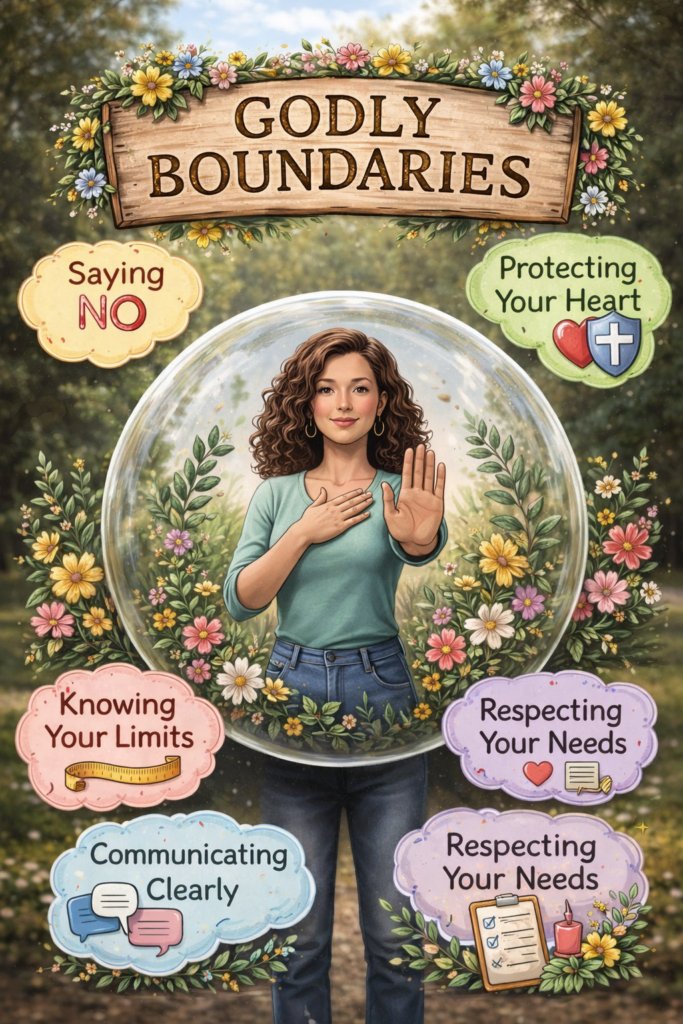
The Importance of Godly Boundaries: Living in Wisdom, Love, and Respect
By Pastor Joel – Open Heaven Christian Church – Fisher, Arkansas
As believers in Christ, we are called to love one another, to serve, and to live in harmony with others. But often, in our pursuit of kindness and compassion, we may neglect one important principle: the importance of setting godly boundaries. Boundaries are not just about protecting ourselves; they are also about maintaining a healthy, respectful relationship with others.
In this blog post, we will explore the biblical concept of boundaries and why setting them is not a sign of selfishness or a lack of love, but rather a way to live wisely, honor God, and preserve the integrity of our relationships.
What Are Boundaries?
In simple terms, boundaries are the limits we set in our lives—whether emotional, physical, mental, or spiritual—that define where one person ends and another begins. These boundaries help us safeguard our well-being, maintain our personal dignity, and foster relationships based on mutual respect.
Boundaries are not just a modern psychological concept; they are deeply rooted in Scripture. The Bible speaks about boundaries in various ways, offering us wisdom on how to live a balanced life that honors God and serves others. Let’s take a look at some key Scriptures that highlight the importance of boundaries.
1. Proverbs 22:28 – “Remove not the ancient landmark…”
“Remove not the ancient landmark, which thy fathers have set.”
In ancient Israel, landmarks were used for property boundaries, ensuring that people knew their responsibilities and possessions. To remove these landmarks was to dishonor the established order. Likewise, in our lives, there are “landmarks” that we should not remove—clear moral and spiritual boundaries that guide our actions and decisions. By maintaining these boundaries, we preserve order, respect. and avoid confusion or conflict.
As believers, we are called to uphold the principles and teachings of God’s Word, which serve as our spiritual landmarks. These landmarks guide us in how we interact with others, protect us from harm that people who have no boundaries inflict on others knowingly or unknowingly, and maintaining healthy boundaries help us honor God in all things and maintains ones peace before God and others.
Removing godly boundaries opens the door to unhealthy conversations and behaviors that will always make one feel confused and overwhelmed because boundaries were crossed.
2. Proverbs 4:23 – “Keep thy heart with all diligence…”
“Keep thy heart with all diligence; for out of it are the issues of life.”
Our hearts are the wellspring of our thoughts, emotions, and actions. If we are not vigilant in guarding our hearts by setting godly boundaries based on the word of God, we may allow unhealthy influences from others who are not living godly lives to take root. This is where boundaries come in. We must be intentional about what we allow to influence our hearts—whether it’s the media we consume, the relationships we cultivate, strangers we encounter and interact with, or the thoughts we entertain.
Setting boundaries on what we expose our hearts to helps protect our spiritual health and keeps us in alignment with God’s will. This isn’t about isolating ourselves from others, but about exercising wisdom in how we guard our inner life.
Guarding ones heart from people who have ill intentions is wise and necessary when interacting with other people because you really do not know their hearts intention even if they are, or not believer in Christ, and slso because not everyone is walking in true obedience to the word of God and not everyone is walking in the love of God or have good intentions toward others.
3. Galatians 6:4-5 – “Let every man prove his own work…”
“But let every man prove his own work, and then shall he have rejoicing in himself alone, and not in another. For every man shall bear his own burden.”
This passage reminds us of personal responsibility. God has entrusted each of us with specific work, tasks, and responsibilities. It’s important not to overstep into others’ areas of responsibility or to carry burdens that are not ours to bear. The bible does teach that we are to bear one anothers burdens, but “bearing” them for others does not mean we make them ours.
“Bear ye one another’s burdens, and so fulfil the law of Christ.” – Galatians 6:2
The word “bear” in the Greek means: bastazó: To bear, carry, endure, support. Bear It does not mean you make their burdens yours.
While it is okay and good to care, assist and help others with their burdens, faults and behavioral issues they are dealing with, one must always guard their heart because it is important to maintain good healthy godly boundaries or you too will end up tempted and overwhelmed while helping others.
“Brethren, if a man be overtaken in a fault, ye which are spiritual, restore such an one in the spirit of meekness; considering thyself, lest thou also be tempted. Bear ye one another’s burdens, and so fulfil the law of Christ.” – Galatians 6:1-2
The Lord teaches that every believer must carry their own cross or (burdens of life) and follow Jesus. Others who assist in helping people during trying times are necessary because it demonstrates the love of God, but ultimately God holds people accountable to carry their own spiritual cross and follow the Lord. Cross bearing are the issues of life we all experience from time to time.
While these issues at times will seem heavey and hard, they are there for one reason, it is exactly with what God is wanting to correct or change in ones life so they can fulfill the perfect will of God in their life. The burdens we all have to bear should be viewed as the way in which we come to a full surrender to doing the will of God and not as something to complain about. Jesus was also was faced with carring the burden of the entire world on his shoulders and never complained, he did pray to the father and asked if it were possible to remove the burden or (cup) he was carrying and said these words, nevertheless, your will be done.
“Saying, Father, if thou be willing, remove this cup from me: nevertheless not my will, but thine, be done.” – Luke 22:42
The father did not remove the burden, instead God the father allowed Jesus to bear the sin of the world. Jesus understood and knew that God wanted him to overcome the challenge he faced at the cross. And Jesus taught that we too must not only understand that we must follow through the challenges we all face in life by carrying our cross as Jesus did when faced with hard trials and temptaions in life. This is a hugh part of discipleship training by God who is working all things out for our good. (Romans 8:28)
“And whosoever doth not bear his cross, and come after me, cannot be my disciple.” – Luke 14:27
Setting godly boundaries in our work, relationships, and responsibilities helps us stay focused on our own tasks while respecting the boundaries of others. It allows us to celebrate our own growth and achievements without comparing ourselves to others or taking on things that God has not called us to.
4. 2 Corinthians 10:13-16 – “We will not boast of things without our measure…”
“But we will not boast of things without our measure, but according to the measure of the rule which God hath distributed to us, a measure to reach even unto you.”
Paul speaks here about not going beyond the boundaries that God has set for his ministry. Each person has a specific role to play, and it’s crucial that we respect the limits of our own calling. By doing so, we avoid stepping into areas where we are not called or equipped, which can lead to frustration and division.
God has placed limits in our lives for our good. Understanding and respecting these limits is essential in fulfilling God’s calling without overextending ourselves or it can lead or cause spiritual harm to others. Jesus is the savior, not ministries who are assisting others in their temptations and distress.
“In my distress I called upon the LORD, and cried unto my God: he heard my voice out of his temple, and my cry came before him, even into his ears.” – Psalm 18:6
5. Psalm 16:6 – “The lines are fallen unto me in pleasant places…”
“The lines are fallen unto me in pleasant places; yea, I have a goodly heritage.”
Here, the psalmist reflects on how God has established good boundaries in his life. These “lines” represent the boundaries that define the psalmist’s life—his territory, his calling, and his place in God’s plan. The psalmist finds joy in knowing that these boundaries are not restrictive but lead to a life of peace and fulfillment and peace.
As believers, we can take comfort in knowing that the boundaries God has set for us are good and that within those limits, we find His peace and blessings.
6. Acts 17:26 – “And hath determined the bounds of their habitation…”
“And hath made of one blood all nations of men for to dwell on all the face of the earth, and hath determined the times before appointed, and the bounds of their habitation.”
God is sovereign over the boundaries of even the nations, places, and times. He has determined where people live and when they live, demonstrating His authority and wisdom in setting limits. This serves as a reminder that boundaries are not only personal but also part of God’s greater plan for all in the world.
7. Proverbs 25:17 – “Withdraw thy foot from thy neighbour’s house…”
“Withdraw thy foot from thy neighbour’s house; lest he be weary of thee, and so hate thee.”
This practical wisdom from Proverbs speaks about respecting others’ space and time. Even in our relationships, there are limits that must be respected. Overstepping those boundaries—whether emotionally, physically, or socially—can strain relationships and cause resentment.
Healthy boundaries in relationships help ensure that both parties can give and receive love without feeling overwhelmed or neglected.
When others fail in respecting the boundaries of others, weariness will sets in and make one feel overwhelmed without realizing what has happened to them, but when healthy boundaries are in place, one will always fell respected and will always respect others.
When boundaries are crossed because when people you interact with do not respect your boundaries , it may be necessary to withdraw yourself from them. This is biblical and sometimes necessary so you can maintain healthy and godly boundaries and because not everyone you are interacting with have set godly boundaries from things they should not be doing as we read in scripture. Certain character traits in others should be avoided.
2 Timothy 3:1-9
“1This know also, that in the last days perilous times shall come. 2For men shall be lovers of their own selves, covetous, boasters, proud, blasphemers, disobedient to parents, unthankful, unholy, 3Without natural affection, trucebreakers, false accusers, incontinent, fierce, despisers of those that are good, 4Traitors, heady, highminded, lovers of pleasures more than lovers of God; 5Having a form of godliness, but denying the power thereof: from such turn away. 6For of this sort are they which creep into houses, and lead captive silly women laden with sins, led away with divers lusts, 7Ever learning, and never able to come to the knowledge of the truth. 8Now as Jannes and Jambres withstood Moses, so do these also resist the truth: men of corrupt minds, reprobate concerning the faith. 9But they shall proceed no further: for their folly shall be manifest unto all men, as theirs also was.”
Boundaries and the Love of God
One of the biggest misconceptions about boundaries is that setting them somehow means we are not walking in love toward others. However, this is not true. Boundaries are actually an expression of love—both for ourselves and for others.
Self-Love and Preservation: Setting boundaries helps protect our physical, emotional, and spiritual well-being. Loving ourselves enough to establish limits is necessary for us to be able to love others in a healthy, sustainable godly way.
Loving Others Respectfully: Boundaries also show respect for others. By honoring their limits, we demonstrate love in a way that recognizes their needs and desires. When we respect others’ boundaries, we are fostering trust and understanding in our relationships.
God’s Love: God Himself set boundaries in His relationship with humanity. He defined what was good and what was not. He set limits on sin, offered grace, and called us to live within His commands for our own flourishing. By setting boundaries, we are simply reflecting God’s own wisdom and love.
The greatest boundary God set is found in John 3:16 and demonstrates that God has drawn a line as to who will spend eternity with Him.
“For God so loved the world, that he gave his only begotten Son, that whosoever believeth in him should not perish, but have everlasting life.” – John 3:16
Truth to God is of the highest importance, and anyone who does not respect the boundaries that God has set will be dammed by God because they refuse to live a righteous life based on the truth.
“That they all might be damned who believed not the truth, but had pleasure in unrighteousness.” – 2 Thessalonians 2:12
The Bible teaches believers that they should focus on their lives.
“And that ye study to be quiet, and to do your own business, and to work with your own hands, as we commanded you;” – 1 Thessalonians 4:11
Every believer is responsible for their own behaviours and actions before the Lord and must focus on their life before God.
“Wherefore, my beloved, as ye have always obeyed, not as in my presence only, but now much more in my absence, work out your own salvation with fear and trembling.” – Philippians 2:12
Conclusion
Godly boundaries are an essential part of living a wise, loving, and peaceful life. They protect our hearts, preserve our relationships, and honor the work God has entrusted to all of us who believe in the Lord. Setting boundaries does not mean one is being unloving or selfish; rather, it means they are caring for others in a way that allows them to serve God and others effectively.
As believers, let us embrace the boundaries God has set for us, and let us set wise, loving boundaries in our own lives. In doing so, we honor God, protect our well-being, and build stronger, healthier relationships that reflect His love and grace.