The Journey from Faith to Charity: How God Fills the Empty Places Within
By Pastor Joel – Open Heaven Christian Church – Fisher, Arkansas
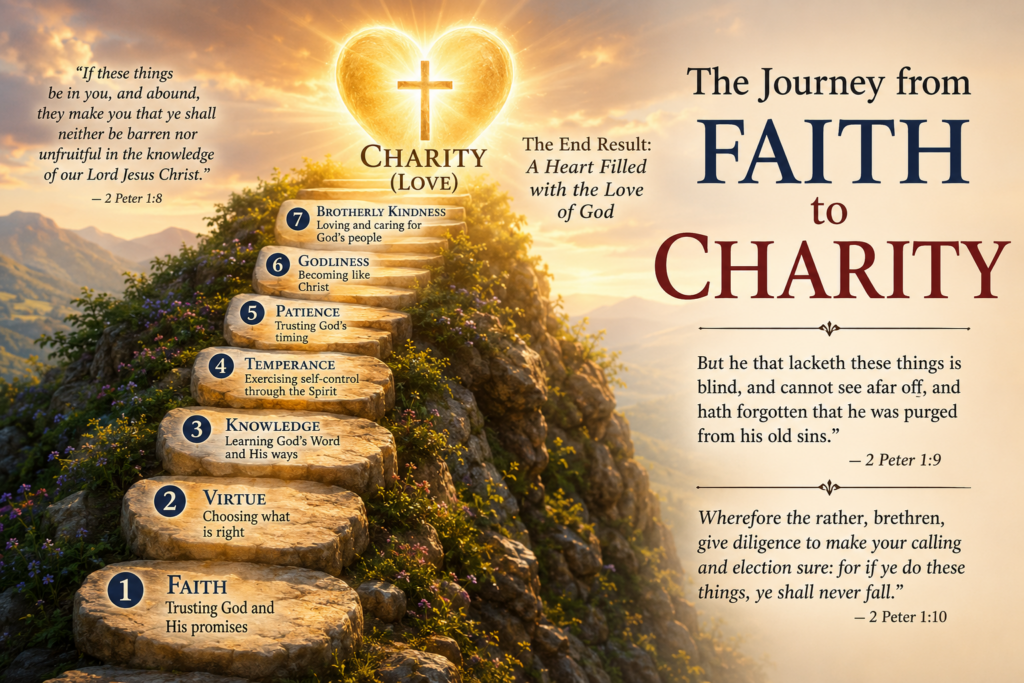
2 Peter 1:5-7 (KJV)
“And beside this, giving all diligence, add to your faith virtue; and to virtue knowledge; And to knowledge temperance; and to temperance patience; and to patience godliness; And to godliness brotherly kindness; and to brotherly kindness charity.”
Peter list 7 things that we are to add to our faith in God.
Virtue
Knowledge
Temperance
Patience
Godliness
Brotherly Kindness
Charity (Love)
Every human heart longs for something that this world can never truly satisfy. People search for fulfillment through success, relationships, possessions, entertainment, pleasure, education, or even religion itself, yet many still carry an emptiness deep within. God never intended for His children to live with that emptiness. Instead, He reveals a divine process by which He transforms us until our hearts are filled with His own love.
The love is God is the ultimate goal and highest gift that God has given to every believer in Jesus because God is love. The method in which one receives the love of God is by the Holy Spirit to bring hope into the heart of God’s children.
Romans 5:5
And hope maketh not ashamed; because the love of God is shed abroad in our hearts by the Holy Ghost which is given unto us.
The Apostle Peter does not simply give us a random list of Christian virtues found in 2 Peter 1:5-7. He presents a spiritual progression. Each characteristic builds upon the previous one, preparing the believer for the next stage of spiritual maturity. The destination of this journey is charity—the selfless, unconditional love of God dwelling within us.
This progression is not merely about becoming a better person. It is about becoming more like Jesus Christ Jesus.
Galatians 4:19
My little children, of whom I travail in birth again until Christ be formed in you.
Faith: The Beginning of the Journey
Everything begins with faith in God.
Faith is trusting God before we see the outcome. It is believing His promises, accepting Christ as Savior, and choosing to walk with Him. Without faith it is impossible to please God (Hebrews 11:6).
Yet Peter says faith is only the foundation.
Faith opens the door, but God desires to build an entire spiritual house upon it.
Many believers remain frustrated because they stop growing after faith. They know Christ, they read their bible and pray, yet still struggle with emptiness, insecurity, doubts at times, and spiritual instability because God intends for faith to mature into something greater.
Virtue: Choosing What Is Right
Peter next says to add virtue.
Virtue speaks of moral excellence and courage to do what is right.
Once faith is born, the believer begins making choices that honor God rather than self. Sin no longer becomes acceptable because the Holy Spirit begins changing the heart.
Virtue is faith becoming visible.
Faith says, “I believe God.”
Virtue says, “Therefore I will live differently then the life I am living now, and begin living the life that Jesus offers me.”
Galatians 2:20
I am crucified with Christ: nevertheless I live; yet not I, but Christ liveth in me: and the life which I now live in the flesh I live by the faith of the Son of God, who loved me, and gave himself for me.
Knowledge: Learning God’s Ways
Virtue is followed by knowledge.
As we walk in obedience, God begins teaching us His Word.
Knowledge is far more than collecting Bible verses and the ability to quote scriptures.
It is learning God’s character.
It is understanding His heart.
It is discovering His wisdom.
The more we know Him, the more we begin seeing life through His eyes instead of our own.
To know God is to experience what the Apostle Peter in 2 Peter 1:5-7 add to your faith Charity-love.
1 John 4:8
He that loveth not knoweth not God; for God is love.
Temperance: Learning Self-Control
Knowledge without self-control can produce pride.
Therefore Peter says to add temperance.
Temperance means self-control through the power of the Holy Spirit.
We begin learning to govern our emotions, appetites, desires, speech, anger, and reactions.
Instead of being controlled by the flesh, we become controlled by the Spirit.
The believer begins saying no to self so they can say yes to God.
1 Corinthians 9:25
And every man that striveth for the mastery is temperate in all things. Now they do it to obtain a corruptible crown; but we an incorruptible.
Patience: Trusting God’s Timing
Once self-control begins growing, God teaches us patience.
Patience is one of the hardest lessons in the Christian life.
God allows delays.
He allows unanswered questions.
He allows trials.
He allows seasons where nothing seems to happen.
During these moments, patience is developed.
Patience teaches us that God’s timing is always perfect.
Instead of demanding immediate answers, we learn to rest in His sovereignty.
Psalms 37:3-7
3 Trust in the LORD, and do good; so shalt thou dwell in the land, and verily thou shalt be fed.
4 Delight thyself also in the LORD; and he shall give thee the desires of thine heart.
5 Commit thy way unto the LORD; trust also in him; and he shall bring it to pass.
6 And he shall bring forth thy righteousness as the light, and thy judgment as the noonday.
7 Rest in the LORD, and wait patiently for him: fret not thyself because of him who prospereth in his way, because of the man who bringeth wicked devices to pass.
Godliness: Becoming Like Christ
Patience gradually produces godliness.
Godliness is not simply appearing religious.
It is developing the very character of Christ.
His humility.
His compassion.
His holiness.
His mercy.
His forgiveness.
The believer begins reflecting Jesus in daily life.
Others begin seeing Christ through us.
Brotherly Kindness: Loving Fellow Believers
Godliness naturally leads to brotherly kindness.
The Greek word translated here is philadelphia—brotherly affection.
As Christ changes us, we genuinely begin caring for others.
Competition becomes cooperation.
Jealousy becomes encouragement.
Judgment becomes compassion.
The Christian family becomes precious.
We begin loving God’s people because God’s Spirit lives within us.
Charity: The Fullness of God’s Love
Finally Peter says to add charity (love).
This is the highest expression of Christian maturity.
The word “charity” is translated from the Greek word agapē, referring to God’s unconditional, sacrificial love.
This love is not based on feelings.
It is not earned.
It is not dependent upon how others treat us.
It is God’s own love flowing through a surrendered heart.
This is the destination toward which every previous characteristic has been leading.
Faith prepared the foundation.
Virtue purified our conduct.
Knowledge renewed our minds.
Temperance disciplined our desires.
Patience strengthened our endurance.
Godliness transformed our character.
Brotherly kindness softened our hearts.
Then God poured His own love into us.
Walking the journey of faith is to understand that God is love.
1 John 4:16
And we have known and believed the love that God hath to us. God is love; and he that dwelleth in love dwelleth in God, and God in him.
As a believer walks his or her journey in life, God will bring them to a place in their life where they will begin to learn and understand that Jesus commanded all of God’s children to walk in the love of God toward other brothers and sisters in the Lord.
1 John 4:20-21
20 If a man say, I love God, and hateth his brother, he is a liar: for he that loveth not his brother whom he hath seen, how can he love God whom he hath not seen? 21 And this commandment have we from him, That he who loveth God love his brother also.
Why Charity Comes Last in 2 Peter 1:5-7
Love is a fruit of the Holy Spirit and is listed as the first fruit of the Spirit in Galatians 5:22, yet in the Apostle Peter’s epistle it is listed as the last characteristic listed only after one has added to their faith Virtue, Knowledge, Temperance, Patience, Godliness, and Brotherly Kindness.
There is profound wisdom in the order Peter gives.
God does not begin by commanding us to love everyone with divine love. This is something we experience as we grow in the Lord and in our everyday walk with Him.
Instead, God transforms us step by step until our hearts become capable of expressing His love.
Many people attempt to manufacture love through human efforts.
Eventually they become exhausted.
God’s charity is different.
It is produced by His Spirit because it is a fruit of the Holy Spirit, and after He has reshaped the believer’s entire life through life experiences will they know and understand the love of God.
The fruit comes naturally because the tree has first been transformed by the power of the Holy Spirit.
The Empty Heart Becomes Full
Many people carry an emptiness they cannot explain.
Some attempt to fill it with relationships.
Others pursue money.
Some seek entertainment.
Others chase achievements, addictions, or endless distractions.
Yet the emptiness remains.
Why?
Because the heart was created for God’s love.
Only the Creator can satisfy what He created.
As the believer walks through Peter’s progression, something remarkable happens.
Faith gives hope.
Virtue brings peace with God.
Knowledge removes confusion.
Temperance frees us from destructive behaviors.
Patience replaces anxiety with trust.
Godliness brings us into deeper fellowship with Christ.
Brotherly kindness connects us with God’s family.
Finally, charity fills every empty place within the soul and there is no more room for emptiness.
The heart no longer searches for fulfillment in temporary things because it has found its home in the love of God.
The believer discovers that what they were truly longing for was not another possession or another experience.
They were longing for Him.
Paul expressed this truth in Romans 5:5:
And hope maketh not ashamed; because the love of God is shed abroad in our hearts by the Holy Ghost which is given unto us.
God does not merely tell us He loves us.
He pours His love into our hearts through the Holy Ghost.
The emptiness that once cried out for meaning becomes filled with His presence.
His peace replaces fear.
His joy replaces loneliness.
His love replaces the aching void that nothing else or no one could satisfy except God.
The Promise of Spiritual Fruitfulness
Peter concludes with an encouraging promise:
“For if these things be in you, and abound, they make you that ye shall neither be barren nor unfruitful in the knowledge of our Lord Jesus Christ.” (2 Peter 1:8)
A believer who continually grows through these characteristics does not live a barren Christian life.
Their relationship with Christ becomes fruitful.
Their prayers become deeper.
Their witness becomes stronger.
Their peace becomes steadier.
Their love becomes richer.
God’s life begins overflowing into everyone around them.
A believer then will begin to experience what Jesus meant when He said I am come that they might have life!
John 10:10
The thief cometh not, but for to steal, and to kill, and to destroy: I am come that they might have life, and that they might have it more abundantly.
Peter also gives a solemn warning:
“But he that lacketh these things is blind, and cannot see afar off, and hath forgotten that he was purged from his old sins.” (2 Peter 1:9)
When we neglect spiritual growth, our vision becomes clouded. We lose sight of God’s eternal purposes and begin living as though our old life still defines us. Peter reminds us to remember that we have been cleansed, redeemed, and called to keep growing in Christ, and walking in His love.
Finally, Peter gives this promise:
“Wherefore the rather, brethren, give diligence to make your calling and election sure: for if ye do these things, ye shall never fall.” (2 Peter 1:10)
Never fail? What was Peter teaching us?
I am convinced that Peter was teaching us all that we will never fail because one who walks in love will never fail because the love in them is God, and love never fails.
1 Corinthians 13:8
Charity never faileth: but whether there be prophecies, they shall fail; whether there be tongues, they shall cease; whether there be knowledge, it shall vanish away.
This does not teach sinless perfection. Rather, it speaks of spiritual stability. A believer who diligently cultivates these qualities is not easily shaken by false doctrine, temptations that lead one astray, or the changing circumstances of life because they have become firmly rooted in Christ and His love.
Conclusion
Peter’s list is much more than a checklist of Christian virtues. It is God’s blueprint for spiritual transformation that brings fulfillment in life.
Every step prepares us for the next until His own love completely fills our hearts. (Romans 5:5)
When charity becomes the ruling principle of our lives, we no longer live from a place of emptiness but from a place of divine spiritual abundance. We cease searching for fulfillment in the passing things of this world because we have discovered the One who satisfies the deepest hunger of the soul.
The love of God is the final destination and highest calling of Christian maturity for every believer.
When His love fills the heart, the emptiness disappears, and the void and lack in our hearts gets filled.
The restless soul finds rest.
The searching heart finds home.
The believer discovers that Christ Himself has always been the treasure they were seeking.
Closing Scripture:
Mark 12:30
And thou shalt love the Lord thy God with all thy heart, and with all thy soul, and with all thy mind, and with all thy strength: this is the first commandment.